
DSIP 10mg
$60.00
DSIP peptide is a synthetic nonapeptide researched for its relationship with sleep architecture, neuroendocrine signaling, stress responses and mitochondrial physiology. Its sequence is Trp-Ala-Gly-Gly-Asp-Ala-Ser-Gly-Glu (WAGGDASGE).
Supplied strictly for qualified laboratory and in-vitro research. Not intended for human or veterinary use.
DSIP Peptide – Delta Sleep-Inducing Peptide Research
Introduction to DSIP Peptide
DSIP peptide, or Delta Sleep-Inducing Peptide, is a nine-amino-acid neuropeptide first isolated during experimental sleep research in rabbits.
Its sequence is:
Trp-Ala-Gly-Gly-Asp-Ala-Ser-Gly-Glu
One-letter sequence:
WAGGDASGE
The name Delta Sleep-Inducing Peptide originated from the circumstances surrounding its discovery. Early experiments associated DSIP with slow-wave EEG activity, leading researchers to investigate its potential relationship with sleep regulation.
Subsequent research has shown a considerably more complex picture.
Although several early human and animal studies reported sleep-associated effects, later investigations produced inconsistent findings. Consequently, DSIP peptide is best regarded as an experimental neuropeptide for studying sleep physiology, neuroendocrine signaling, stress responses and related pathways rather than as an established sleep-promoting compound.
DSIP Peptide Molecular Specifications
| Property | Specification |
|---|---|
| Compound | Delta Sleep-Inducing Peptide |
| Abbreviation | DSIP |
| Alternative name | Emideltide |
| Peptide type | Linear nonapeptide |
| Sequence | Trp-Ala-Gly-Gly-Asp-Ala-Ser-Gly-Glu |
| One-letter sequence | WAGGDASGE |
| Amino-acid count | 9 |
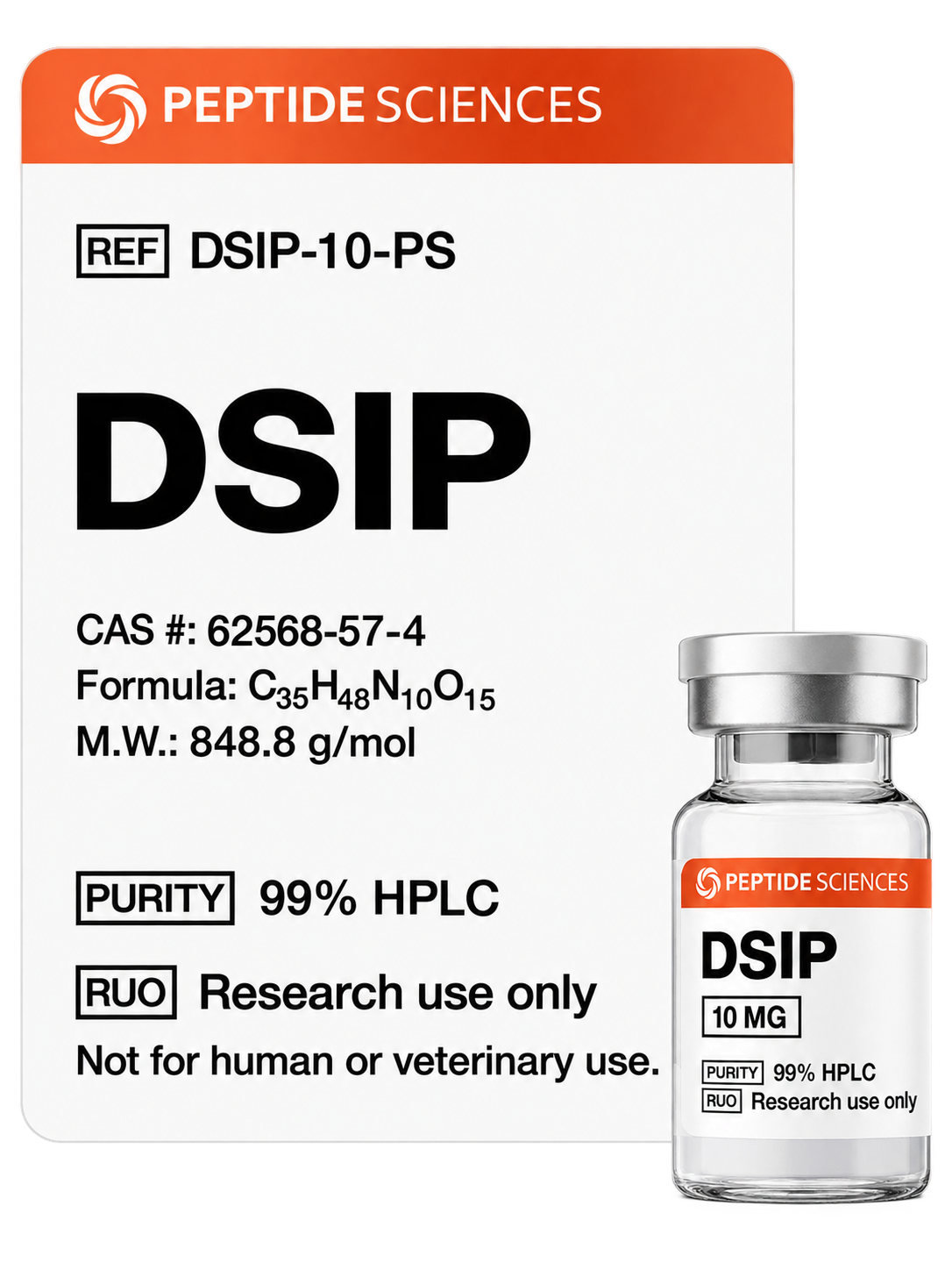
| Molecular formula | C35H48N10O15 |
| Molecular weight | Approximately 848.8 g/mol |
| Common CAS number | 62568-57-4 |
| PubChem CID | 68816 |
| Research category | Neuromodulatory peptide |
| Intended use | Laboratory research only |
Product quantity, purity, salt form and storage specifications should be taken from the current product label or batch documentation because those details were not supplied in the source material.
DSIP Peptide and Sleep Research
The historical research surrounding DSIP peptide largely concerns sleep architecture and sleep-onset physiology.
Early experiments demonstrated that the peptide could influence slow-wave EEG patterns in certain animal models.
Small human studies subsequently investigated DSIP in individuals with chronic insomnia.
A placebo-controlled study involving 16 chronic-insomnia subjects reported higher sleep efficiency and shorter sleep latency in the DSIP group. However, the investigators emphasized that these effects were weak, some may have reflected changes within the placebo group, and short-term DSIP treatment was unlikely to provide major therapeutic benefit.
Other studies have reported improvements in aspects of sleep structure, while separate experiments found little clinically meaningful difference.
This mixed evidence makes DSIP useful for studying:
- Sleep architecture
- Sleep latency
- Slow-wave sleep
- Circadian-associated signaling
- Neuroendocrine regulation
- Sleep-wake physiology
Rather than claiming that the DSIP peptide reliably induces deep sleep, it is more accurate to describe its relationship with sleep as an unresolved research question.
DSIP Peptide Sequence and Discovery
The DSIP peptide sequence was established as:
Trp-Ala-Gly-Gly-Asp-Ala-Ser-Gly-Glu
The compound was originally isolated from cerebral venous blood collected from rabbits subjected to experimental thalamic stimulation.
It was subsequently synthesized and evaluated in controlled animal models.
DSIP is structurally unusual because its sequence does not closely resemble the major classical neuropeptide families.
Later reviews have also questioned whether naturally occurring DSIP exists primarily in the exact free nonapeptide form or whether DSIP-like immunoreactivity may partly represent related molecular species.
This remains an important topic for researchers studying the endogenous biology of the peptide.
DSIP and Somatostatin Research
One of the stronger mechanistic findings associated with DSIP peptide comes from research involving somatostatin.
An in-vitro rat hypothalamic median-eminence study found that DSIP inhibited somatostatin release in a concentration-dependent manner.
The effect was blocked by the dopamine-receptor antagonist pimozide, leading the investigators to propose a dopaminergic mechanism.
This provides a legitimate experimental basis for studying:
- Somatostatin release
- Dopaminergic signaling
- Hypothalamic peptide regulation
- Neuroendocrine feedback
However, this finding should not be translated into claims that DSIP promotes human muscle growth or provides growth-hormone-related performance benefits.
DSIP Peptide and Pain-Pathway Research
Historical research has also examined DSIP peptide in pain-associated models.
A very small pilot study involving seven individuals with chronic pain conditions reported reductions in pain ratings in six participants.
Animal experiments have also reported antinociceptive responses following central administration of DSIP.
Some studies found that opioid antagonism altered these responses, suggesting a possible interaction with opioid-associated signaling.
However, other experiments produced different findings.
For this reason, it is more accurate to describe DSIP as being studied for interactions with opioid and nociceptive pathways rather than stating that it directly activates opioid receptors.
The limited and historical nature of the human data should also be considered.
DSIP Peptide and Withdrawal Research
Early clinical research investigated DSIP in individuals experiencing alcohol- or opioid-associated withdrawal symptoms.
One historical study evaluated 67 patients, although a substantial proportion were not suitable for final evaluation.
The investigators reported favorable outcomes among many of the evaluable participants.
These findings are scientifically interesting but come from older clinical research and have not established DSIP peptideas a modern approved treatment for substance withdrawal.
For laboratory purposes, the literature may support investigation into:
- Stress-associated signaling
- Neurotransmitter pathways
- Opioid-system interactions
- Neuroendocrine responses
- Behavioral stress models
DSIP and Mitochondrial Stress Research
The source material also describes mitochondrial and hypoxia-associated research.
A rat study investigating isolated brain mitochondria reported that DSIP altered oxidative phosphorylation parameters and increased measures including phosphorylated respiration and respiratory-control ratio.
In animals subjected to experimental hypoxia, pretreatment also influenced mitochondrial respiratory responses.
This supports controlled investigation of DSIP peptide in areas such as:
- Oxidative phosphorylation
- Mitochondrial respiration
- ATP-associated pathways
- Hypoxia-related stress
- Cellular stress responses
These findings were obtained largely from rat and isolated-mitochondrial models and should not be presented as evidence that DSIP prevents stroke, heart attack or human tissue injury.
DSIP Peptide and Aging Research
A preparation containing DSIP known as Deltaran has been investigated in long-term mouse experiments.
One study reported changes in chromosome-aberration frequency and spontaneous tumor incidence as well as increased maximum lifespan measurements in the treated animals.
However, mean lifespan was not increased.
These findings are preclinical and involve a particular DSIP-containing experimental preparation.
Accordingly, DSIP peptide benefits should not be described as proven anti-aging, longevity or anticancer effects in humans.
Instead, these studies make DSIP potentially relevant to laboratory investigation of:
- Aging-associated biomarkers
- Stress physiology
- Chromosomal instability
- Experimental longevity models
- Spontaneous tumor development in animal models
Understanding DSIP Peptide Benefits
The phrase DSIP peptide benefits commonly appears in online searches, but the scientific evidence requires careful interpretation.
For research purposes, useful characteristics of DSIP include its relevance to several experimental systems involving:
- Sleep physiology
- Circadian signaling
- Neuroendocrine regulation
- Somatostatin pathways
- Mitochondrial stress
- Pain-associated signaling
- Stress adaptation
These represent areas of investigation, not established medical benefits.
The current evidence does not justify claiming that DSIP reliably treats insomnia, anxiety, depression, chronic pain, addiction, cancer or cardiovascular disease.
DSIP Peptide Dosage Clarification
Searches for DSIP peptide dosage often refer to human administration.
Peptide Science does not provide human dosage recommendations for this laboratory research material.
Any quantity listed on the product label refers to the amount of research compound supplied, not a human dose.
Experimental concentration should be selected by qualified researchers according to:
- Study design
- Assay type
- Cell or tissue model
- Experimental endpoint
- Published methodology
No human administration protocol is provided.
Quality and Analytical Verification
Researchers evaluating a DSIP peptide should confirm molecular identity using appropriate analytical documentation.
Relevant analytical characteristics may include:
- HPLC purity
- Mass-spectrometry identity
- Expected molecular mass
- Peptide sequence
- Batch or lot number
- Certificate of Analysis
For the free peptide, the expected molecular mass is approximately 848.8 g/mol.
Salt forms or analytical adducts may produce different measured ion signals, so researchers should rely on the batch-specific analytical report when evaluating individual material.
Related Research Areas
DSIP overlaps with several major areas of neuropeptide research, including:
Sleep and Circadian Biology
Studies investigating sleep structure, sleep onset and biological rhythms.
Neuroendocrine Signaling
Research involving somatostatin, hypothalamic pathways and endocrine regulatory systems.
Mitochondrial Stress Biology
Experimental studies involving oxidative phosphorylation, hypoxia and cellular stress.
Neuromodulation
Investigation of pain-associated, dopaminergic and opioid-linked signaling pathways.
These research categories highlight why the DSIP peptide continues to attract scientific interest despite uncertainty surrounding its natural biological role.
DSIP Peptide FAQ
What is DSIP peptide?
DSIP peptide stands for Delta Sleep-Inducing Peptide, a synthetic nonapeptide originally identified during sleep research.
What is the DSIP peptide sequence?
The sequence is:
Trp-Ala-Gly-Gly-Asp-Ala-Ser-Gly-Glu
or WAGGDASGE.
How many amino acids does DSIP contain?
DSIP contains nine amino acids and is therefore classified as a nonapeptide.
What is the molecular formula of DSIP?
The molecular formula is:
C35H48N10O15
What is the molecular weight of DSIP?
The molecular weight of the free peptide is approximately 848.8 g/mol.
What is the CAS number of DSIP?
The CAS number most commonly associated with the PubChem DSIP record is 62568-57-4.
Does DSIP peptide induce deep sleep?
Its name originated from early experiments in which sleep-associated effects were observed.
However, subsequent animal and human studies have produced mixed findings, and later reviews describe DSIP’s relationship with sleep as unresolved.
What are DSIP peptide benefits?
The phrase DSIP peptide benefits should refer to potential research utility rather than human therapeutic benefits.
Research areas include sleep physiology, neuroendocrine signaling, mitochondrial stress and nociceptive pathways.
Is DSIP peptide studied for insomnia?
Yes.
Several older controlled human studies investigated DSIP in chronic insomnia, but results were mixed and some researchers concluded that the observed short-term effects were of limited clinical significance.
Does DSIP affect somatostatin?
An in-vitro rat hypothalamic study reported concentration-dependent inhibition of somatostatin release through a mechanism that appeared to involve dopaminergic signaling.
Does DSIP interact with opioid pathways?
Animal and historical clinical studies suggest interactions between DSIP and opioid-associated pathways.
The evidence does not establish DSIP as a conventional opioid-receptor agonist, so this mechanism should be described cautiously.
Is DSIP studied for mitochondrial function?
Yes.
Preclinical research has examined DSIP in rat-brain mitochondrial respiration, oxidative phosphorylation and experimental hypoxia models.
Does DSIP treat cancer?
No established evidence supports DSIP as a cancer treatment.
Some DSIP-containing preparations have been studied in mouse tumor-incidence models, but those results remain preclinical.
What is DSIP peptide dosage?
DSIP peptide dosage for human use is not provided.
This product is intended strictly for qualified laboratory research.
Is DSIP FDA approved?
DSIP is not an FDA-approved therapeutic product.
Is DSIP intended for human use?
No.
The product is supplied strictly for laboratory and scientific research and is not intended for human or veterinary consumption, therapeutic administration or clinical diagnostics.
DSIP Peptide Research Use Disclaimer
The DSIP peptide supplied by Peptide Science is intended strictly for qualified laboratory and in-vitro research.
References to sleep physiology, somatostatin, opioid-associated pathways, mitochondrial function, oxidative stress, pain models, aging or tumor research describe areas investigated in published scientific literature and do not constitute therapeutic claims.
The product is not intended to diagnose, treat, cure or prevent insomnia, anxiety, depression, chronic pain, substance withdrawal, cancer, cardiovascular disease or any other medical condition.
It is not intended for human or veterinary consumption, self-administration, therapeutic use or clinical diagnostics.
Reviews
Clear filtersThere are no reviews yet.