
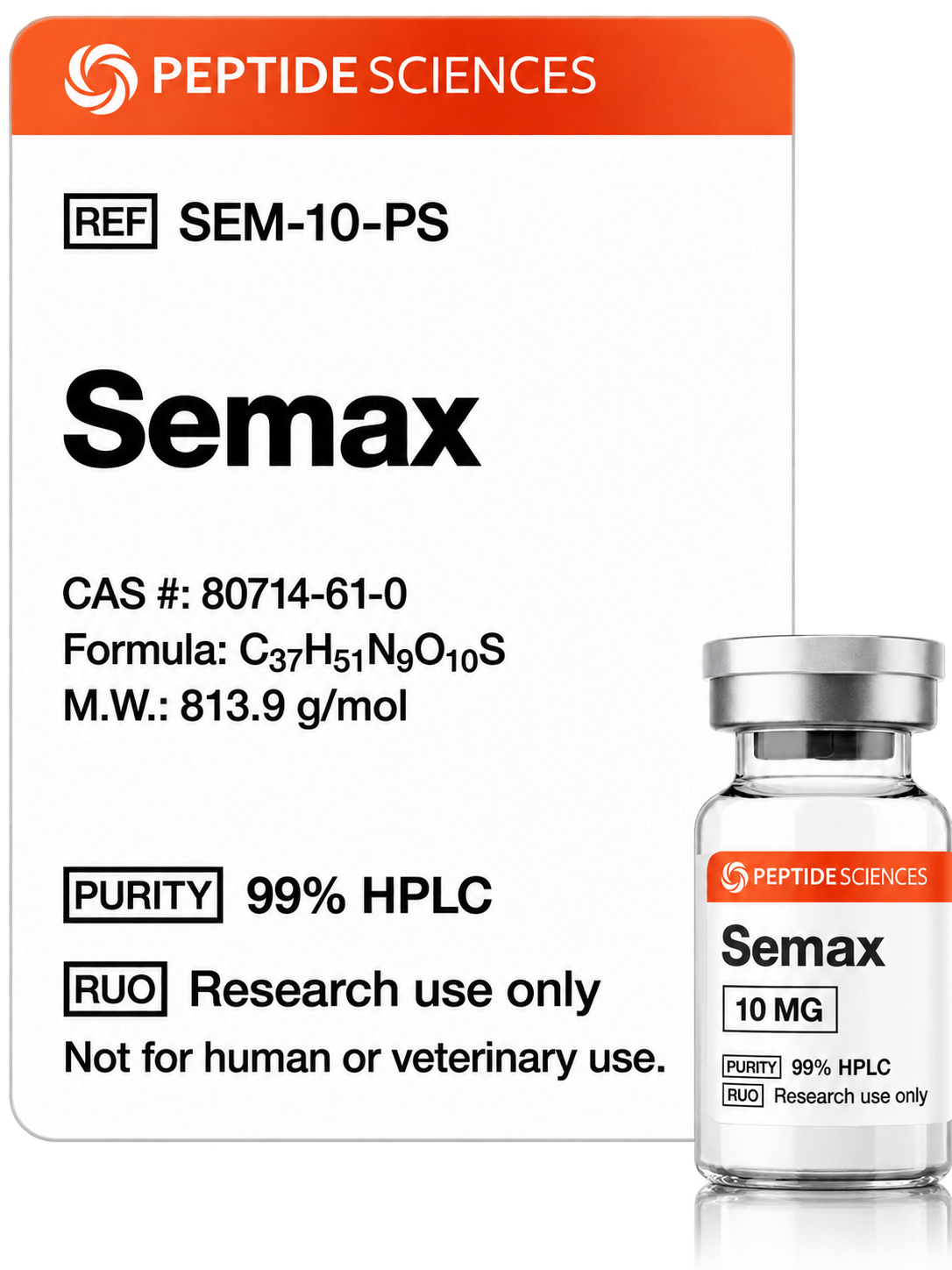
Semax 10mg
$57.00
Semax peptide is a synthetic seven-amino-acid research peptide composed of the ACTH(4–7) sequence followed by Pro-Gly-Pro. It is widely investigated in laboratory models involving BDNF, NGF, neurotrophic signaling, gene expression, brain-network activity and stress-associated neuronal pathways.
Strictly for laboratory and in-vitro research only. Not intended for human or veterinary administration.
Semax Peptide – ACTH(4–7)-PGP Neurotrophic Research Peptide
Introduction to Semax Peptide
Semax peptide is a synthetic heptapeptide represented by the amino-acid sequence:
Met-Glu-His-Phe-Pro-Gly-Pro
One-letter sequence:
MEHFPGP
Semax was developed from the N-terminal ACTH(4–7) fragment, Met-Glu-His-Phe, with the addition of the tripeptide Pro-Gly-Pro (PGP).
It is therefore more accurate to describe Semax as an ACTH(4–7)-PGP analogue or analogue of ACTH(4–10), rather than stating that it consists directly of the unchanged ACTH amino acids 4 through 10.
The structural modification was designed to preserve neuroactive research properties while separating the peptide from the classical hormonal activity associated with full-length adrenocorticotropic hormone.
At Peptide Science, Semax is positioned strictly as a laboratory research peptide for controlled investigation of neurotrophic signaling, gene expression and neuronal-response pathways.
Semax Peptide Molecular Specifications
| Property | Specification |
|---|---|
| Compound | Semax |
| Sequence | Met-Glu-His-Phe-Pro-Gly-Pro |
| One-letter sequence | MEHFPGP |
| Peptide length | 7 amino acids |
| Structural description | ACTH(4–7)-Pro-Gly-Pro |
| Molecular formula | C37H51N9O10S |
| Molecular weight | Approximately 813.9 g/mol |
| CAS number | 80714-61-0 |
| Classification | Synthetic ACTH-derived heptapeptide |
| Research areas | Neurotrophic, gene-expression and neuronal signaling |
| Intended use | Laboratory research only |
Purity, vial quantity, salt form and storage specifications should be taken from the applicable product label or batch-specific Certificate of Analysis when those details are available.
Semax Peptide and BDNF Research
One of the most extensively investigated mechanisms associated with Semax peptide is regulation of brain-derived neurotrophic factor, or BDNF.
BDNF is a neurotrophin involved in:
- Neuronal survival
- Synaptic plasticity
- Learning-associated pathways
- Memory-associated signaling
- Neuronal differentiation
- Activity-dependent neural adaptation
Rat studies have reported changes in Bdnf expression after Semax exposure in brain regions including the hippocampus and frontal cortex.
Other experimental work has reported increased BDNF protein levels in the basal forebrain and identified specific, reversible Semax-binding activity in membrane preparations from this region.
These findings provide a strong basis for laboratory investigation of the Semax peptide in neurotrophin-associated models.
They should not be interpreted as evidence that research-grade Semax automatically improves memory or cognition in humans.
Semax and NGF Gene Expression
Semax research also includes the neurotrophin nerve growth factor, or NGF.
Studies in rats have demonstrated changes in both Bdnf and Ngf gene expression following Semax exposure.
The response can differ according to:
- Brain region
- Time after exposure
- Experimental model
- Tissue type
For example, research has reported different early responses between the hippocampus and frontal cortex before subsequent increases in neurotrophin-related gene expression.
This regional and time-dependent behavior is important because it shows that Semax peptide activity should not be reduced to a simple claim that it continuously “raises BDNF and NGF.”
The biological response is more complex and experimentally dependent.
Semax Peptide and Gene-Expression Research
Transcriptomic and gene-expression studies have made Semax an interesting tool for molecular neuroscience.
Researchers have investigated changes involving genes associated with:
- Neurotrophin signaling
- Immune-system responses
- Vascular biology
- Chemokines
- Inflammatory signaling
- Cellular stress
- Synaptic function
In experimental cerebral-ischemia models, Semax has altered transcription patterns involving immune- and vascular-associated genes.
Other studies have reported activation of neurotrophin and neurotrophin-receptor genes following experimental ischemia.
These findings support the use of Semax peptide as a research probe for examining coordinated gene-expression responses under neuronal stress.
Semax and Default Mode Network Research
Human neuroimaging research has also examined Semax.
A resting-state functional MRI study evaluated healthy volunteers before and after Semax or placebo exposure.
The researchers reported a greater volume of the rostral component of the default mode network (DMN) in the Semax group.
The DMN is a large-scale brain network associated with internally oriented cognition and resting-state brain activity.
This study is scientifically useful because it provides evidence that Semax can be investigated beyond isolated molecular pathways and within whole-brain functional-network models.
However, the study was small and should not be interpreted as proof that the Semax peptide enhances intelligence, social cognition or general cognitive performance.
Semax Peptide and Ischemia Research
A considerable portion of published Semax research concerns experimental cerebral ischemia and stroke-associated models.
Animal studies have examined Semax in relation to:
- Neuronal survival
- Neurotrophin expression
- Immune-associated gene expression
- Vascular-system gene expression
- Hypoxic stress
- Post-ischemic molecular signaling
Clinical studies conducted outside the United States have also evaluated Semax in ischemic-stroke patients.
One study involving 110 post-stroke patients reported increased plasma BDNF levels in groups receiving Semax and investigated relationships among BDNF, rehabilitation timing and functional outcomes.
Earlier clinical work also evaluated Semax alongside conventional therapy in acute ischemic stroke.
These studies form part of the scientific literature surrounding the compound.
They do not establish the Peptide Science research material as an approved stroke therapy.
Semax Peptide Benefits in Research
The phrase Semax peptide benefits frequently appears in searches, but for a research-only product it should describe experimental characteristics rather than therapeutic outcomes.
Potential research advantages include:
- Defined seven-residue structure
- ACTH-derived peptide architecture
- Extensive neurotrophin research
- BDNF-associated studies
- NGF-associated studies
- Gene-expression research
- Neural-network imaging research
- Experimental stress and ischemia models
These Semax peptide benefits relate to research utility.
They do not establish that Semax treats cognitive impairment, depression, anxiety, stroke or neurological disease.
Semax and Dopamine, Serotonin and Enkephalin Research
Semax literature also includes investigations involving neurotransmitter systems.
Experimental studies have explored relationships with:
- Dopaminergic signaling
- Serotonergic signaling
- Enkephalin metabolism
- Neurochemical responses to stress
- Behavioral models
These pathways may help researchers investigate how ACTH-derived peptides influence neural signaling.
However, it is better to describe Semax as modulating or interacting with neurotransmitter-associated systems in experimental models than to state that it directly or predictably increases dopamine, serotonin or enkephalins in every system.
Semax and Behavioral Research
Preclinical studies have investigated Semax peptide in behavioral models associated with:
- Learning
- Memory
- Stress
- Anxiety-like behavior
- Depressive-like behavior
- Attention
Such findings are useful for experimental neuroscience but remain highly model-dependent.
Animal behavioral endpoints do not automatically predict human cognitive or psychiatric outcomes.
For this reason, Peptide Science does not represent Semax as an antidepressant, anxiolytic, cognitive enhancer or approved nootropic treatment.
Semax Peptide Sequence
The Semax peptide sequence is:
Met-Glu-His-Phe-Pro-Gly-Pro
or:
MEHFPGP
The first four residues correspond to ACTH(4–7):
Met-Glu-His-Phe
The final three residues form:
Pro-Gly-Pro
This ACTH(4–7)-PGP architecture is an important structural distinction from the natural ACTH(4–10) sequence.
Semax Peptide Dosage Clarification
Searches for Semax peptide dosage commonly reflect human-use intent.
Peptide Science does not provide human administration or dosage recommendations.
Any milligram amount shown on the product label represents the quantity of research material supplied, not:
- A daily human dose
- An intranasal protocol
- An injection protocol
- A therapeutic regimen
- A veterinary dose
Qualified researchers should determine experimental concentrations according to their specific in-vitro, cellular, tissue or analytical protocol.
Quality and Analytical Verification
Research laboratories working with Semax peptide should verify material identity using batch-specific analytical documentation.
Relevant quality parameters can include:
- HPLC purity
- Mass-spectrometry identity
- Expected molecular mass
- Sequence confirmation
- Lot identification
- Certificate of Analysis
The expected molecular mass of free Semax is approximately 813.9 g/mol.
Salt forms or analytical adducts may produce different measured masses and should be interpreted using the corresponding laboratory report.
Semax Peptide FAQ
What is Semax peptide?
Semax peptide is a synthetic seven-amino-acid ACTH-derived peptide composed of ACTH(4–7) followed by Pro-Gly-Pro.
What is the Semax peptide sequence?
The sequence is:
Met-Glu-His-Phe-Pro-Gly-Pro
or MEHFPGP.
Is Semax ACTH(4–10)?
Semax is commonly described as an analogue of ACTH(4–10), but its exact sequence is not identical to native ACTH residues 4–10.
It consists of ACTH(4–7) followed by Pro-Gly-Pro.
How many amino acids are in Semax?
Semax contains seven amino acids and is therefore a heptapeptide.
What is the molecular formula of Semax?
The molecular formula of the free peptide is:
C37H51N9O10S
What is the molecular weight?
The molecular weight is approximately:
813.9 g/mol.
What is the CAS number for Semax?
The commonly referenced CAS number is:
80714-61-0.
Does Semax affect BDNF?
Rat and cell studies have reported changes in BDNF gene expression and BDNF protein levels following Semax exposure.
These findings provide a basis for neurotrophin research but should not be interpreted as guaranteed human effects.
Does Semax affect NGF?
Yes, experimental rat studies have reported time- and region-dependent changes in NGF gene expression.
What are Semax peptide benefits?
Semax peptide benefits in this context refer to research utility in neurotrophin, gene-expression, neuronal signaling and brain-network studies.
They are not established therapeutic benefits.
Does Semax improve memory?
Semax has been investigated in memory and learning models, particularly in animals.
These findings do not establish that Peptide Science research material improves human memory.
Is Semax an antidepressant?
Preclinical research has investigated Semax in behavioral and neurochemical models associated with depressive-like behavior.
That does not establish it as an approved antidepressant treatment.
Is Semax studied in humans?
Yes.
Published studies include small healthy-volunteer neuroimaging research and clinical investigations in stroke populations.
Those studies do not convert research-grade Semax into an approved medical treatment.
Does Semax affect the default mode network?
A small resting-state fMRI study reported differences in the rostral default-mode-network component after Semax exposure compared with placebo.
Further research is required to determine the broader significance of this finding.
What is Semax peptide dosage?
Peptide Science does not provide human Semax peptide dosage guidance.
Experimental concentrations should be determined exclusively according to controlled laboratory protocols.
Is Semax intended for human use?
No.
The Peptide Science product is supplied strictly for laboratory and in-vitro research.
It is not intended for human or veterinary consumption, self-administration, cognitive enhancement, psychiatric treatment, stroke treatment or clinical diagnostics.
Semax Peptide Research Use Disclaimer
The Semax peptide supplied by Peptide Science is designated strictly for qualified laboratory and in-vitro research.
References to BDNF, NGF, gene expression, default mode network activity, dopamine, serotonin, enkephalin pathways, ischemia or behavioral models describe published areas of scientific investigation and do not constitute therapeutic claims.
This product is not intended to diagnose, treat, cure or prevent neurological, psychiatric, cerebrovascular or other medical conditions.
It is not intended for human or veterinary consumption, self-administration, therapeutic administration or clinical diagnostic use.
Reviews
Clear filtersThere are no reviews yet.