
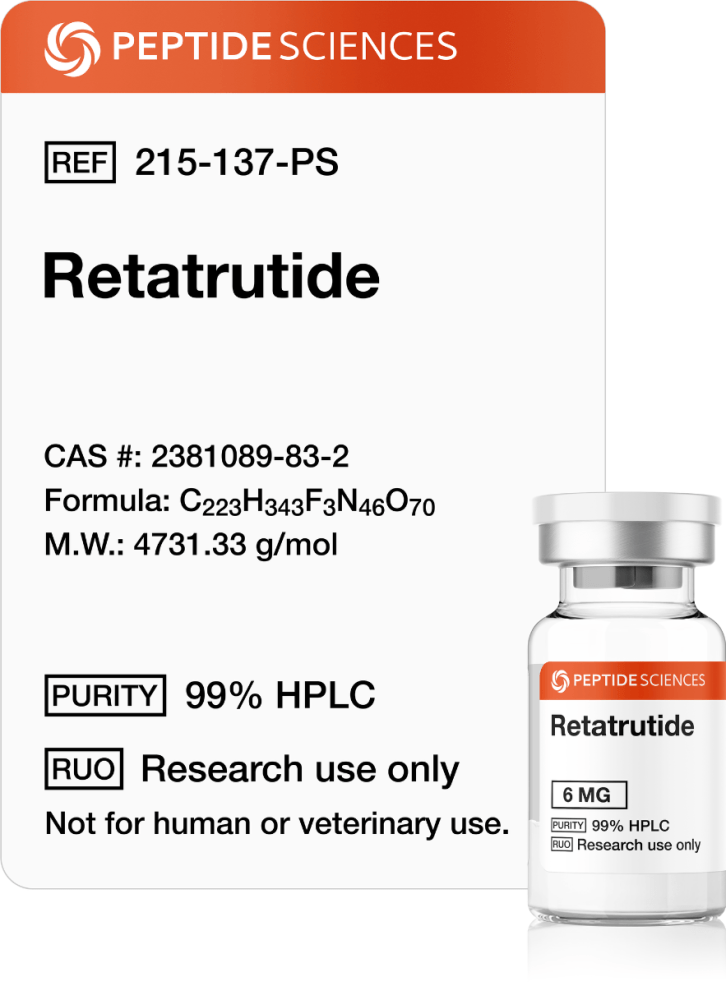
Research Chem Retatrutide 6mg
$180.00
PRODUCT SHORT DESCRIPTION
Retatrutide 6mg is a cutting-edge, synthetic single-peptide multi-agonist engineered to simultaneously target the GIP, GLP-1, and glucagon receptors. This 6mg formulation provides a premier baseline concentration for investigating triple-hormone receptor synergy, advanced metabolic profiling, and mitochondrial energy expenditure.
Research Chem Retatrutide 6mg – Triple-Receptor Research Peptide
Introduction to Research Chem Retatrutide 6mg
Retatrutide 6mg is an advanced synthetic peptide representing the frontier of multi-receptor incretin and metabolic research. Engineered as a single-sequence multi-agonist, Retatrutide has activity at three distinct metabolic receptor systems: the glucose-dependent insulinotropic polypeptide (GIP) receptor, glucagon-like peptide-1 (GLP-1) receptor, and glucagon receptor (GCGR).
This triple-receptor architecture distinguishes Retatrutide from compounds designed primarily around single- or dual-receptor signaling.
At USA PEPTIDE SCIENCES, we supply this research chem retatrutide material in a 6mg lyophilized format, providing qualified laboratories with a stable research matrix for controlled investigation of multi-receptor signaling, endocrine pathways, metabolic regulation, and systemic bioenergetics.
For scientists searching for research chem retatrutide, the 6mg configuration provides a standardized research peptide intended exclusively for qualified laboratory and in-vitro investigation.
Research Chem Retatrutide Research Overview
The scientific utility of Retatrutide lies in its multi-agonist molecular architecture.
The peptide is based on a GIP-related backbone incorporating structural modifications and fatty-diacid acylation designed to alter stability and pharmacokinetic behavior. Through simultaneous activity at GIPR, GLP-1R, and GCGR, research chem retatrutide provides laboratories with a single molecular platform for examining interactions among three important metabolic signaling pathways.
Research Chem Retatrutide Applications
Key areas of active scientific investigation include:
- Multi-Receptor Co-Activation Kinetics: Evaluating binding and downstream intracellular signaling associated with concurrent GIP, GLP-1, and glucagon receptor activation.
- GIP Receptor Signaling: Investigating glucose-dependent insulinotropic pathways and their interactions with other incretin-associated receptor systems.
- GLP-1 Receptor Research: Studying cellular signaling associated with GLP-1R activation in endocrine and metabolic experimental models.
- Glucagon Receptor Signaling: Examining GCGR-associated hepatic, metabolic, substrate-utilization, and energy-regulation pathways.
- Mitochondrial and Bioenergetic Research: Investigating relationships between multi-receptor activation, cellular energy utilization, substrate oxidation, and metabolic signaling.
- Pancreatic Beta-Cell Models: Studying GIP- and GLP-1-associated signaling in experimental beta-cell systems.
- Hepatic Lipid Research: Evaluating liver-associated lipid metabolism and related metabolic pathways under controlled experimental conditions.
Researchers evaluating research chem retatrutide can review Retatrutide triple-receptor research on PubMed for peer-reviewed literature involving GIPR, GLP-1R, GCGR, and related metabolic pathways.
Research Chem Retatrutide Triple-Receptor Architecture
Retatrutide is scientifically notable because one peptide interacts with three receptor systems.
GIP Receptor
The GIP component of research chem retatrutide research enables investigation of glucose-dependent insulinotropic signaling and the interaction of GIPR with broader metabolic pathways.
GLP-1 Receptor
GLP-1 receptor agonism provides a second signaling axis for research involving pancreatic, gastrointestinal, neuroendocrine, and metabolic processes.
Glucagon Receptor
GCGR activity creates an additional experimental pathway involving hepatic signaling, substrate metabolism, and energy expenditure.
The combined GIPR/GLP-1R/GCGR architecture allows research chem retatrutide to be compared with single- and dual-receptor research peptides.
Retatrutide Research Chem Compound Profile
- Compound: Retatrutide
- Development designation: LY3437943
- Research class: Triple-receptor peptide agonist
- Peptide length: 39 amino acids
- Primary receptor targets: GIPR, GLP-1R, and GCGR
- Structural feature: Fatty-diacid acylation
- Quantity: 6mg
- Format: Lyophilized research peptide
- Purity: ≥99% according to supplied specifications
- Testing: High-Performance Liquid Chromatography and Mass Spectrometry
- Primary research areas: Incretin signaling, glucagon signaling, metabolic pathways, endocrine research, and bioenergetics
- Intended use: Laboratory and in-vitro research only
Research Chem Retatrutide and Metabolic Pathway Research
Because Retatrutide combines three receptor activities, researchers can investigate how receptor-specific responses overlap within integrated metabolic systems.
Experimental research chem retatrutide studies may examine:
- GIPR signaling
- GLP-1R signaling
- GCGR signaling
- Receptor cross-talk
- Glucose-associated signaling
- Pancreatic beta-cell pathways
- Hepatic lipid metabolism
- Substrate utilization
- Energy-expenditure mechanisms
- Mitochondrial-associated pathways
- Endocrine transcriptional responses
These research areas should not be interpreted as claims that the USA Peptide Sciences material produces therapeutic, metabolic, or weight-management effects in humans.
Research Chem Retatrutide Quality Standards & Analytical Testing
At USA PEPTIDE SCIENCES, maintaining data integrity is a foundational component of our research-material standards.
The Retatrutide 6mg formulation is produced under rigorous quality-control procedures designed to minimize experimental variability.
We utilize High-Performance Liquid Chromatography (HPLC) to verify a chemical purity profile of 99% or greateraccording to the supplied specifications.
Mass Spectrometry (MS) is additionally used to verify molecular identity and structural characteristics associated with the Retatrutide peptide.
A comprehensive batch-specific Certificate of Analysis (COA) accompanies each order according to the supplied product information, providing researchers with additional compound traceability.
For laboratories comparing research chem retatrutide across repeated assays, consistent analytical characterization is particularly important for maintaining reproducible baseline conditions.
Research Chem Retatrutide Storage and Handling Requirements
To safeguard the structural integrity of Retatrutide 6mg, the vacuum-sealed lyophilized research material should be stored long-term at -20°C according to the supplied product specifications.
Prior to laboratory assays, reconstitution should be performed using an appropriate sterile or bacteriostatic research diluent.
Following controlled reconstitution, the peptide should be maintained under refrigeration between 2°C and 8°C.
Researchers should dissolve the material through gentle, slow rotation and avoid aggressive mechanical agitation or shaking.
Related Research Chem Retatrutide Compounds
Researchers studying research chem retatrutide or comparing alternative metabolic research mechanisms may also explore:
- Research chem Retatrutide comparison – Adipotide FTPP 10mg — a distinct vascular-targeting peptide platform for comparative adipose-tissue and metabolic research.
- Research chem Retatrutide comparison – AOD9604 Peptide 6mg — related metabolic research peptide for comparative C-terminal growth-hormone-fragment studies.
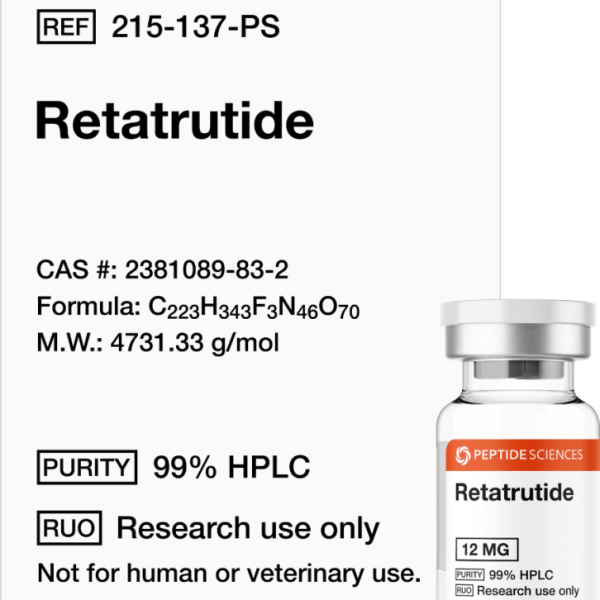
- Research chem Retatrutide comparison – Retatrutide 12mg — an alternative Retatrutide research quantity for appropriately designed laboratory protocols.
Research Chem Retatrutide FAQ
What is research chem retatrutide?
Research chem retatrutide is a search phrase used for Retatrutide supplied as an investigational laboratory research peptide.
Scientifically, Retatrutide is a peptide agonist with activity at GIP, GLP-1, and glucagon receptors.
What is Retatrutide?
Retatrutide, also known by the development designation LY3437943, is a synthetic multi-receptor peptide investigated for agonist activity at GIPR, GLP-1R, and GCGR.
Is research chem retatrutide a peptide?
Yes. Research chem retatrutide is a peptide research compound rather than a conventional small-molecule research chemical.
The phrase “research chem” represents search intent and laboratory-product terminology rather than its precise molecular classification.
How many amino acids are in Retatrutide?
Retatrutide is described as a 39-amino-acid peptide.
What receptors does research chem retatrutide target?
Research chem retatrutide is investigated for activity at three receptor systems:
- GIP receptor
- GLP-1 receptor
- Glucagon receptor
This is why Retatrutide is commonly described in scientific literature as a triple-hormone-receptor agonist.
Why is Retatrutide called a triple agonist?
Retatrutide is called a triple agonist because the same peptide has agonist activity at GIPR, GLP-1R, and GCGR.
What is retatrutide research chem studied for?
The phrase retatrutide research chem generally refers to laboratory research involving Retatrutide and its three receptor pathways.
Research interests include incretin signaling, glucagon signaling, metabolic regulation, hepatic pathways, pancreatic models, energy expenditure, and receptor cross-talk.
What is science bio retatrutide?
Science bio retatrutide is a search phrase that may refer to people seeking Retatrutide information or material associated with another supplier or brand.
The product on this page is supplied specifically by USA Peptide Sciences. No affiliation with Science.bio or another similarly named supplier is stated or implied.
Is research chem retatrutide the same as Tirzepatide?
No. Research chem retatrutide and Tirzepatide are distinct peptides.
Retatrutide is investigated as a GIP/GLP-1/glucagon triple-receptor agonist, whereas Tirzepatide is characterized primarily as a dual GIP/GLP-1 receptor agonist.
How does Retatrutide differ from AOD9604?
Retatrutide and AOD9604 Peptide 6mg represent different research architectures.
Retatrutide involves GIPR, GLP-1R, and GCGR activity, whereas AOD9604 is associated with C-terminal growth-hormone-fragment research.
How does Retatrutide differ from Adipotide?
Retatrutide is a triple-receptor peptide agonist, whereas Adipotide FTPP 10mg is investigated as a targeted pro-apoptotic peptide involving adipose-tissue vasculature.
Is Retatrutide available as 12mg?
Yes. Researchers requiring another laboratory quantity can review Retatrutide 12mg research peptide for appropriately designed experimental protocols.
What purity is research chem retatrutide 6mg?
According to the supplied product specifications, research chem retatrutide has a purity profile of 99% or greater, with HPLC used for purity analysis and Mass Spectrometry for identity verification.
Does Retatrutide 6mg include a Certificate of Analysis?
Yes. According to the supplied product information, each Retatrutide 6mg research order includes batch-specific Certificate of Analysis documentation.
How should research chem retatrutide be stored?
According to the supplied specifications, research chem retatrutide should be stored at -20°C while lyophilized.
Following controlled laboratory reconstitution, the peptide should be maintained between 2°C and 8°C.
Can researchers find research chem retatrutide studies on PubMed?
Yes. Researchers can review research chem Retatrutide scientific literature on PubMed for studies involving Retatrutide, LY3437943, GIPR, GLP-1R, GCGR, triple-receptor agonism, and related metabolic pathways.
Is research chem retatrutide approved for human use from USA Peptide Sciences?
No. Research chem retatrutide supplied by USA Peptide Sciences is designated strictly for laboratory and in-vitro scientific research.
It is not supplied for human or veterinary consumption, weight-management use, therapeutic administration, clinical diagnostics, or any other human application.
Research Chem Retatrutide 6mg Research Use Disclaimer
The compounds distributed by USA PEPTIDE SCIENCES, including Retatrutide 6mg, are designated strictly for laboratory research purposes only.
The term research chem retatrutide on this page refers exclusively to availability of the peptide as a scientific research material.
Under no circumstances is this product intended for human or veterinary consumption, diagnostic protocols, weight-management treatment, therapeutic administration, or any other human application.
All handling, measuring, and experimental evaluation must be conducted exclusively by qualified scientific professionals within an appropriate controlled research facility.
Lea –
First time using a triple-agonist in research and I’m impressed. Support walked me through reconstitution and handling. Within a few weeks, the appetite suppression was substantial, but what stood out was the sustained energy—unlike semaglutide where my research subjects often showed fatigue . The 6mg vial provided enough for my research cycle. Great product from a reliable vendor.
Winona –
Nia –
Disappointed with this one. The product arrived but the results were underwhelming. I reached out for more details on the research base but didn’t get a clear explanation. I’ve since read that while retatrutide shows impressive Phase 3 data, it remains investigational—not FDA-approved—and the grey-market supply chain raises purity consistency questions . The lack of established protocols for the 6mg dose in my research model and the cardiac considerations made this a tricky tool to work with. I might try a different research approach next time.
Rita –
The quality is solid but I was mindful of the side effect profile. The 6mg dose produced substantial appetite suppression, but the energy increase some users report was less consistent in my models. Phase 2 data showed resting heart rate increases peaked around week 24 before declining . The 6mg vial is convenient, but the variability in response and cardiac considerations were notable.
Cameron –
I’ve been following the GLP-1 polyagonist literature and this retatrutide formulation is exactly what I needed. The support team was responsive, noting the 6mg dose is the low-dose arm in Phase 3 TRIUMPH trials, showing approximately 19% weight loss over 96 weeks . Shipping was prompt with a COA showing excellent purity. Within a few weeks, I observed the expected effects on appetite regulation and metabolic markers. The combination of GLP-1/GIP/glucagon agonism provides a more comprehensive research model than single- or dual-agonists .
Jovan –
Ordering was smooth and the support team provided clear handling guidance for the 6mg research vial. Retatrutide’s unique triple-agonist mechanism—targeting GLP-1, GIP, and glucagon receptors—makes it a compelling tool for metabolic research . I noticed significant appetite suppression and a surprising boost in energy within the first week, which aligns with user reports of reduced “GLP-1 fatigue” . The weight loss results in my research models have been impressive, with steady fat reduction. A quality product for serious research.
Bertram –
Shipping was slightly delayed but the product arrived intact. I observed decent appetite suppression, but some research models showed unexpected effects. The glucagon component drives energy expenditure, but also raises resting heart rate—a unique consideration for retatrutide . Discontinuation rates in Phase 3 were dose-dependent: 4.1% at 4mg, 6.9% at 9mg, and 11.3% at 12mg . At 6mg, effects were moderate but the cardiac and GI considerations require careful protocol design. Good product overall.