
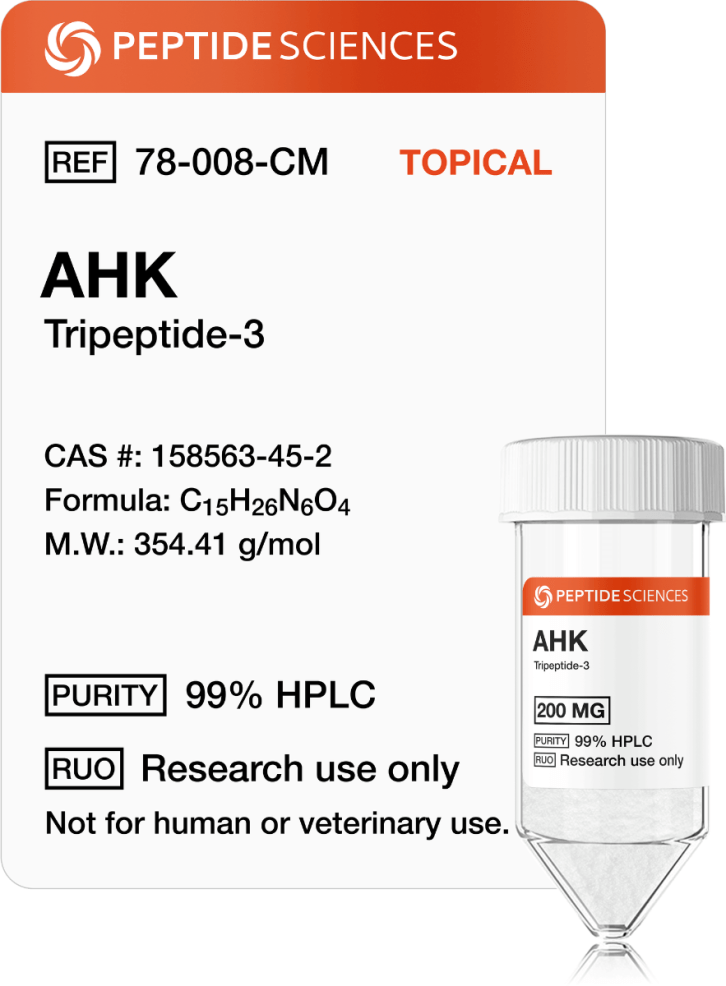
AHK (Tripeptide 3) 200mg (Topical)
$200.00
PRODUCT SHORT DESCRIPTION
AHK (Tripeptide-3) 200mg is a premium, high-purity synthetic topical research peptide engineered for advanced follicular biology, dermal papilla cell activation, and extracellular matrix remodeling investigations. This high-concentration 200mg configuration provides an exceptionally precise biochemical tool for mapping localized tissue regeneration kinetics.
Tripeptide 3 AHK 200mg – Topical Research Peptide
WooCommerce Short Product Description
- AHK 200mg topical laboratory research peptide
- Supplier designation: Tripeptide 3 / AHK
- Sequence: Ala-His-Lys
- Chemical name: L-Alanyl-L-histidyl-L-lysine
- Amino-acid count: 3
- Molecular formula: C15H26N6O4
- Molecular weight: approximately 354.41 g/mol
- CAS number: 126828-32-8
- Form: Lyophilized topical research material
- Purity: ≥99% according to supplied specifications
- Testing: HPLC and Mass Spectrometry
- Research focus: Peptide formulation, copper-binding chemistry, dermal models and comparative tripeptide research
- Strictly for laboratory and in-vitro research only
Introduction to AHK 200mg Tripeptide 3
AHK is the synthetic tripeptide L-alanyl-L-histidyl-L-lysine, represented by the amino-acid sequence:
Ala-His-Lys
or:
AHK
In research-supplier terminology, AHK is sometimes described as tripeptide 3. Because cosmetic peptide nomenclature is not completely consistent across databases and publications, USA Peptide Sciences identifies the actual molecular sequence throughout this page to avoid ambiguity.
At USA PEPTIDE SCIENCES, the AHK tripeptide 3 research material is supplied as a high-concentration 200mg lyophilized product for controlled laboratory and topical-formulation studies.
Its compact three-amino-acid structure makes AHK relevant to investigations involving:
- Peptide physicochemistry
- Topical formulation systems
- Copper-binding chemistry
- Peptide stability
- Model-membrane transport
- Comparative dermal peptide research
- Structure-activity relationships
The supplied product is uncomplexed AHK, not AHK-Cu, unless batch-specific documentation explicitly states otherwise.
What Is Tripeptide 3 AHK?
For this USA Peptide Sciences product, tripeptide 3 refers to the AHK sequence:
Ala-His-Lys
AHK is structurally related to GHK, another three-amino-acid peptide with the sequence Gly-His-Lys.
The difference is at the N-terminal amino acid:
- AHK: Ala-His-Lys
- GHK: Gly-His-Lys
Both peptides contain histidine and lysine residues capable of participating in metal-binding chemistry, but their molecular structures and research evidence should not be treated as interchangeable.
Researchers working with tripeptide 3 should also distinguish free AHK from AHK-Cu, in which the peptide is coordinated with copper.
Tripeptide 3 Research Specifications
| Property | Specification |
|---|---|
| Compound | AHK |
| Supplier/search designation | Tripeptide 3 |
| Chemical name | L-Alanyl-L-histidyl-L-lysine |
| Sequence | Ala-His-Lys |
| One-letter sequence | AHK |
| Amino-acid count | 3 |
| Molecular formula | C15H26N6O4 |
| Molecular weight | Approximately 354.41 g/mol |
| CAS number | 126828-32-8 |
| Research class | Synthetic tripeptide |
| Quantity | 200mg |
| Format | Lyophilized topical research material |
| Purity | ≥99% according to supplied specifications |
| Analytical testing | HPLC and Mass Spectrometry |
| Intended use | Laboratory and in-vitro research only |
Tripeptide 3 vs AHK-Cu
One of the most important distinctions in AHK research is the difference between the free peptide and its copper complex.
Free AHK / Tripeptide 3
The material described on this page is:
Ala-His-Lys
without a copper ion specified as part of the molecular structure.
AHK-Cu
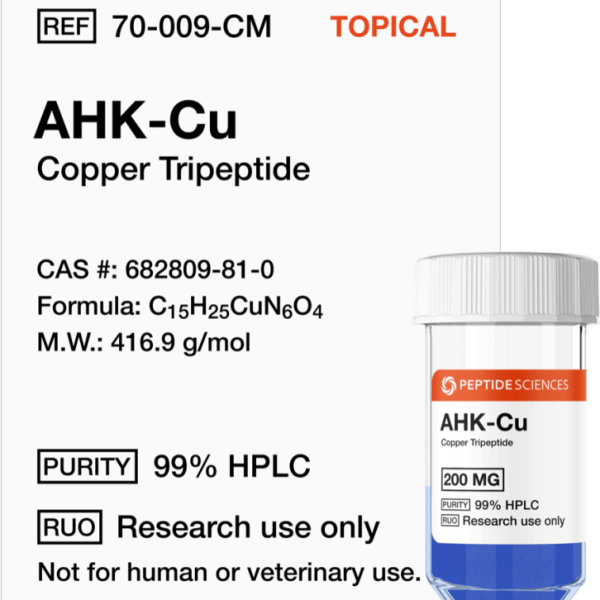
AHK-Cu consists of the same AHK sequence coordinated with copper.
The best-known AHK-specific hair-follicle study used AHK-Cu, not free AHK.
That distinction matters because metal coordination can change:
- Molecular weight
- Charge distribution
- Receptor or protein interactions
- Redox behavior
- Cellular responses
- Experimental stability
For that reason, biological findings obtained with AHK-Cu should not automatically be attributed to the uncomplexed tripeptide 3 material.
AHK-Cu Hair-Follicle Research Context
Published research has investigated AHK-Cu in ex-vivo human hair follicles and cultured dermal papilla cells.
That study reported:
- Increased human hair-follicle elongation ex vivo
- Increased dermal papilla cell proliferation
- Changes in Bcl-2/Bax ratio
- Reduced cleaved caspase-3
- Reduced cleaved PARP
The reduction in apoptotic dermal papilla cells itself was not statistically significant.
This research is scientifically relevant when designing comparative tripeptide 3 experiments, but it concerns the copper-complexed AHK-Cu molecule.
USA Peptide Sciences therefore does not claim that free AHK 200mg has independently demonstrated identical hair-follicle effects.
Researchers can review AHK-Cu hair follicle and dermal papilla research on PubMed for the primary study.
Tripeptide 3 and VEGF Research
VEGF claims surrounding AHK also require careful interpretation.
The published AHK-Cu literature discusses copper-tripeptide effects on fibroblast-associated VEGF production.
However, this evidence does not establish that uncomplexed tripeptide 3 AHK independently produces the same VEGF response.
For free AHK research, VEGF may be included as an experimental endpoint where scientifically appropriate, but it should not be presented as a proven intrinsic effect of the USA Peptide Sciences product.
Tripeptide 3 and TGF-β Research
A similar distinction applies to transforming growth factor beta.
Some AHK-Cu-associated literature discusses changes in TGF-β1 secretion in fibroblast systems.
Because this evidence relates to the copper complex, the free tripeptide 3 product should not be described as conclusively suppressing or activating TGF-β pathways.
Researchers may instead investigate:
- TGF-β signaling
- Fibroblast responses
- Extracellular-matrix markers
- Collagen-associated gene expression
- Peptide-metal interactions
under controlled experimental conditions.
Tripeptide 3 and Collagen Research
AHK is frequently marketed online for collagen and extracellular-matrix applications.
The direct peer-reviewed evidence for uncomplexed AHK itself is substantially thinner than the literature for AHK-Cu, GHK, and GHK-Cu.
Accordingly, the USA Peptide Sciences tripeptide 3 product is best positioned as a research material for investigating collagen-associated and fibroblast endpoints rather than as a peptide already proven to increase specific collagen types.
Appropriate experimental markers may include:
- COL1A1
- COL3A1
- Matrix metalloproteinases
- Fibroblast viability
- Extracellular-matrix proteins
- TGF-β-associated signaling
Any response should be measured experimentally rather than assumed.
Tripeptide 3 Topical Formulation Research
The 200mg format makes tripeptide 3 relevant to controlled formulation-development research.
Laboratories may investigate AHK in:
- Aqueous formulations
- Hydrogels
- Nanoemulsions
- Microemulsions
- Lipid carriers
- Model skin systems
- Membrane-permeation assays
- Stability studies
Peptide delivery through skin-related experimental systems depends on factors including molecular size, charge, formulation vehicle, pH, carrier composition and experimental model.
The small size of AHK alone should not be interpreted as proof that the peptide automatically crosses the human stratum corneum efficiently.
Tripeptide 3 Topical Delivery Research
Published topical-delivery research exists for compounds described as Tripeptide-3, including microemulsion and nanoemulsion systems.
However, because the term Tripeptide-3 is used inconsistently across cosmetic literature, researchers should verify the exact sequence used in each publication before assuming that a study concerns Ala-His-Lys.
This nomenclature issue is especially important for researchers comparing external literature with the USA Peptide Sciences tripeptide 3 AHK product.
For reproducibility, compound identity should always be defined by:
- Sequence
- Molecular formula
- Molecular mass
- Analytical data
- CAS or registry information
- Batch-specific Certificate of Analysis
rather than product nickname alone.
Tripeptide 3 and GHK-Cu Comparison
AHK and GHK-Cu are related but distinct.
AHK has the sequence:
Ala-His-Lys
GHK has the sequence:
Gly-His-Lys
GHK-Cu adds copper coordination to the GHK tripeptide.
Researchers interested in comparing free AHK with a more extensively studied copper peptide can examine GHK-Cu 1000mg Copper Peptide Topical in appropriately designed comparative experiments.
Tripeptide 3 Quality Standards & Analytical Testing
At USA PEPTIDE SCIENCES, laboratory identity and experimental reproducibility are central to research-material quality.
Each AHK tripeptide 3 production lot undergoes analytical evaluation according to the supplied specifications.
High-Performance Liquid Chromatography (HPLC) is used to support purity analysis, while Mass Spectrometry (MS) supports molecular identity verification.
The supplied product specification states a purity profile of 99% or greater.
A batch-specific Certificate of Analysis accompanies each order according to the supplied information.
Claims of complete absence of particular heavy metals, residual solvents or other contaminants should only be made where those individual analyses are documented on the applicable COA.
Tripeptide 3 Storage and Handling Requirements
According to the supplied product specifications, the lyophilized tripeptide 3 material should be stored long-term at -20°C, protected from light and unnecessary moisture exposure.
Prior to controlled laboratory assays, preparation should use an appropriate research-grade solvent or diluent compatible with the experimental design.
Following research reconstitution, the supplied specification calls for storage between 2°C and 8°C.
Researchers should use gentle mixing and avoid unnecessary aggressive mechanical agitation.
These instructions concern laboratory material handling only and are not directions for personal topical application.
Related Tripeptide 3 Research Peptides
Researchers studying tripeptide 3, extracellular-matrix pathways, topical peptide formulations or comparative short-peptide systems may also explore:
- Tripeptide 3 comparison – Syn-Coll Palmitoyl Tripeptide-5 200mg — a palmitoylated signaling peptide for comparative formulation and extracellular-matrix research.
- Tripeptide 3 comparison – Tripeptide-29 200mg Collagen Peptide — related tripeptide material for comparative collagen-associated laboratory studies.
- Tripeptide 3 comparison – GHK-Cu 1000mg Copper Peptide — copper-coordinated tripeptide for comparative metal-binding and dermal-cell research.
Researchers can also review AHK, AHK-Cu and tripeptide research on PubMed for peer-reviewed scientific literature.
Tripeptide 3 FAQ
What is tripeptide 3?
For this USA Peptide Sciences product, tripeptide 3 refers to AHK, the synthetic peptide:
Ala-His-Lys
Because the name Tripeptide-3 is not used consistently in all cosmetic literature, researchers should verify the sequence whenever comparing products or publications.
What is AHK peptide?
AHK is the abbreviation for:
Alanine-Histidine-Lysine
It is a three-amino-acid synthetic peptide with molecular formula C15H26N6O4.
Is AHK the same as Tripeptide 3?
AHK is marketed by some peptide suppliers under the name Tripeptide 3.
However, Tripeptide-3 terminology is not completely standardized across cosmetic and research literature, so the exact sequence Ala-His-Lys should always be specified.
How many amino acids are in tripeptide 3 AHK?
The USA Peptide Sciences tripeptide 3 AHK product contains three amino acids:
- Alanine
- Histidine
- Lysine
What is the molecular weight of AHK?
The molecular weight of free AHK is approximately:
354.41 g/mol
What is the molecular formula of AHK?
The molecular formula is:
C15H26N6O4
What is the CAS number for AHK?
The CAS registry number associated with L-alanyl-L-histidyl-L-lysine is:
126828-32-8
Is tripeptide 3 the same as AHK-Cu?
No.
Free tripeptide 3 AHK consists of Ala-His-Lys.
AHK-Cu is the copper-coordinated form of that peptide.
Copper coordination produces a chemically distinct research material.
Does AHK contain copper?
Not inherently.
The USA Peptide Sciences product described here is free AHK unless the batch documentation specifically identifies copper coordination.
The notation AHK-Cu should only be used when copper is actually part of the supplied compound.
Is tripeptide 3 studied for hair follicles?
The strongest directly relevant hair-follicle study used AHK-Cu, not free AHK.
That study reported increased hair-follicle elongation and dermal papilla cell proliferation in ex-vivo and in-vitro models.
Those results should not automatically be assigned to free tripeptide 3.
Does tripeptide 3 increase VEGF?
AHK-Cu-related research has discussed VEGF-associated effects.
Direct evidence establishing the same effect for uncomplexed AHK is limited, so USA Peptide Sciences does not present VEGF upregulation as a confirmed property of the free peptide.
Does AHK increase collagen?
AHK is relevant to collagen and extracellular-matrix research, but the direct peer-reviewed evidence for free AHK is limited.
Researchers should measure collagen-associated responses experimentally rather than assume that the free peptide reproduces effects reported for copper complexes.
Does tripeptide 3 affect TGF-β?
TGF-β can be investigated as an experimental endpoint in tripeptide 3 research.
However, strong claims that free AHK directly suppresses or activates TGF-β should not be made on the basis of AHK-Cu data alone.
Is AHK the same as GHK?
No.
AHK is:
Ala-His-Lys
GHK is:
Gly-His-Lys
They differ at the first amino-acid residue.
Is AHK the same as GHK-Cu?
No.
AHK is an uncomplexed Ala-His-Lys tripeptide.
GHK-Cu consists of Gly-His-Lys coordinated with copper.
Researchers can compare AHK with GHK-Cu Copper Peptide 1000mg in controlled laboratory experiments.
Is tripeptide 3 a topical cosmetic product?
No.
The USA Peptide Sciences tripeptide 3 200mg material is supplied strictly as laboratory research material.
The “topical” designation refers to the research/formulation category and does not mean it is a finished serum, cream or consumer skincare product.
Can tripeptide 3 be studied in topical formulations?
Yes.
Researchers may investigate tripeptide 3 in controlled formulation systems involving solvents, hydrogels, emulsions, lipid carriers and model-membrane experiments.
Does AHK automatically penetrate human skin because it is small?
No.
Small molecular size may be relevant to formulation research, but transdermal or epidermal penetration depends on multiple physicochemical and formulation variables.
Efficient human skin penetration should not be assumed from peptide length alone.
What purity is tripeptide 3 AHK 200mg?
According to the supplied specifications, tripeptide 3 AHK has a purity profile of 99% or greater, with HPLC and Mass Spectrometry used for analytical evaluation.
Does AHK 200mg include a Certificate of Analysis?
According to the supplied product information, a batch-specific Certificate of Analysis accompanies the research material.
How should tripeptide 3 be stored?
According to the supplied specifications, lyophilized tripeptide 3 should be stored at -20°C and protected from light and moisture.
Following controlled research reconstitution, the supplied storage specification calls for refrigeration between 2°C and 8°C.
What related peptides can researchers compare with AHK?
Researchers studying tripeptide 3 may compare it with Syn-Coll Palmitoyl Tripeptide-5 200mg, Tripeptide-29 200mgand GHK-Cu 1000mg in appropriately designed research models.
Where can researchers find AHK studies?
Researchers can review AHK, AHK-Cu and tripeptide scientific research on PubMed and the AHK-Cu human hair-follicle study for primary research relevant to this peptide family.
Is tripeptide 3 intended for human use?
No.
The tripeptide 3 AHK 200mg material supplied by USA Peptide Sciences is designated strictly for laboratory and in-vitro research.
It is not intended for human or veterinary consumption, personal topical application, hair-growth treatment, cosmetic rejuvenation, therapeutic administration, clinical diagnostics or incorporation into finished consumer products.
Tripeptide 3 AHK 200mg Research Use Disclaimer
The AHK 200mg research peptide, described on this page using the supplier/search designation tripeptide 3, is distributed by USA PEPTIDE SCIENCES strictly for laboratory research and formulation-development purposes.
The compound supplied is identified as Ala-His-Lys (AHK). Research findings involving AHK-Cu, GHK, GHK-Cu or other similarly named tripeptides should not automatically be attributed to this uncomplexed AHK research material.
This product is not intended for human or veterinary consumption, personal topical application, hair-growth treatment, skin treatment, cosmetic use, therapeutic administration or clinical diagnostics.
All handling, measurement, formulation development and experimental evaluation must be conducted exclusively by qualified scientific professionals within an appropriate controlled research environment.
Tre –
The ordering experience was good overall and the product arrived within the estimated timeframe with secure packaging. Customer support was helpful when I asked about mixing ratios, though it took about a day for them to get back to me. In terms of the AHK itself, I have noticed some improvements in my hair shedding and texture, but the effects are more subtle than I anticipated. I followed the recommended concentration and applied it consistently for about 8 weeks, but the improvements in hair density were gradual. I have since read that the entire AHK-Cu-specific peer-reviewed record is a single in-vitro and ex-vivo study from 2007, never replicated, with no human trial of any kind . It definitely seems to support my hair, but I expected more dramatic results. Good product overall, but the limited evidence and gradual effects knocked a star off for me.
Rene –
Lue –
The product quality seems solid and the support team provided clear instructions on reconstitution and handling. Shipping was prompt and the packaging was adequate. I am dropping a star mainly because I found the mixing process somewhat finicky, as the powder needed thorough stirring to dissolve completely in my water-based carrier. I also noticed that the recommended concentration range of 0.1-0.5% required careful calculation for DIY formulation . After adjusting the concentration, my scalp has adapted and I am noticing some improvements in texture and reduced shedding. Solid product, but the mixing challenges and the understanding that AHK is a C-tier compound with modest effect sizes were drawbacks for me .
Beulah –
This was my first time using a copper peptide for hair support and I could not be happier with the experience. The customer support team walked me through the reconstitution process, explaining that the peptide is water-soluble and stable in pH ranges typical for cosmetic products . Shipping was lightning fast and the packaging was professional. I have been using it for about 5 weeks and the improvements are genuinely impressive. My hair feels thicker, I am seeing less shedding, and my scalp feels healthier overall. The in vitro research showing it increases Bcl-2 expression and decreases Bax expression in dermal papilla cells is clearly translating into real-world results for me . This is a great product from a trustworthy vendor.
Ona –
I had a generally positive experience with this vendor, though shipping took a few days longer than estimated. The peptide arrived in good condition and reconstituted without issues. As for the AHK, I have noticed moderate improvements in my hair shedding and texture, but the results are not as dramatic as some of the enthusiastic reviews I have seen. I also understand that AHK-Cu effect sizes are nowhere near minoxidil or finasteride, and that it is best used as a cosmetic adjunct alongside minoxidil rather than a standalone alopecia treatment . The 200mg size is good value, but the effects are subtle and the product requires consistent use over several months. Good product and decent service, but temper your expectations for immediate or transformative results.
Bridgette –
I have been researching copper peptides for a while and this AHK is exactly what I needed as a topical adjunct. The support team was responsive when I reached out about optimal mixing ratios, noting that the histidine residue provides the primary copper chelation site. Shipping was prompt with secure packaging and the product arrived with a Certificate of Analysis confirming high purity. I have been applying this daily for about 6 weeks and have noticed improvements in my hair texture and reduced shedding. The mechanism of action involving copper-mediated upregulation of growth factors near the dermal papilla aligns with my experience . This is a solid product from a vendor that clearly understands peptide science.
Zackery –
The ordering experience was good overall and the product arrived within the estimated timeframe with secure packaging. Customer support was helpful when I asked about mixing ratios, though it took about a day for them to get back to me. In terms of the AHK itself, I have noticed some improvements in my hair shedding and texture, but the effects are more subtle than I anticipated. I followed the recommended concentration and applied it consistently for about 8 weeks, but the improvements in hair density were gradual. I have since read that the entire AHK-Cu-specific peer-reviewed record is a single in-vitro and ex-vivo study from 2007, never replicated, with no human trial of any kind . It definitely seems to support my hair, but I expected more dramatic results. Good product overall, but the limited evidence and gradual effects knocked a star off for me.
Celestine –
Letitia –
I had a fairly disappointing experience with this purchase. The website was easy to use and I received my order within a reasonable timeframe, but when I reconstituted the AHK, I noticed that the powder did not fully dissolve even after thorough mixing, leaving some tiny particulate matter that I was concerned about applying to my scalp. I reached out to support and they suggested adjusting the pH, but it was inconvenient and left me questioning the quality. As for the results, I used the product for several weeks and honestly cannot say I noticed any real difference in my hair shedding, density, or overall scalp health. I understand that AHK-Cu is a real cosmetic ingredient with a plausible mechanism, but randomized controlled trial data supporting its hair growth efficacy does not currently exist . The lack of any noticeable benefits in my case was disappointing. I might try a different vendor or GHK-Cu next time because this just did not work for me.