
Melanostatin DM 200mg (Topical)
$230.00
PRODUCT SHORT DESCRIPTION
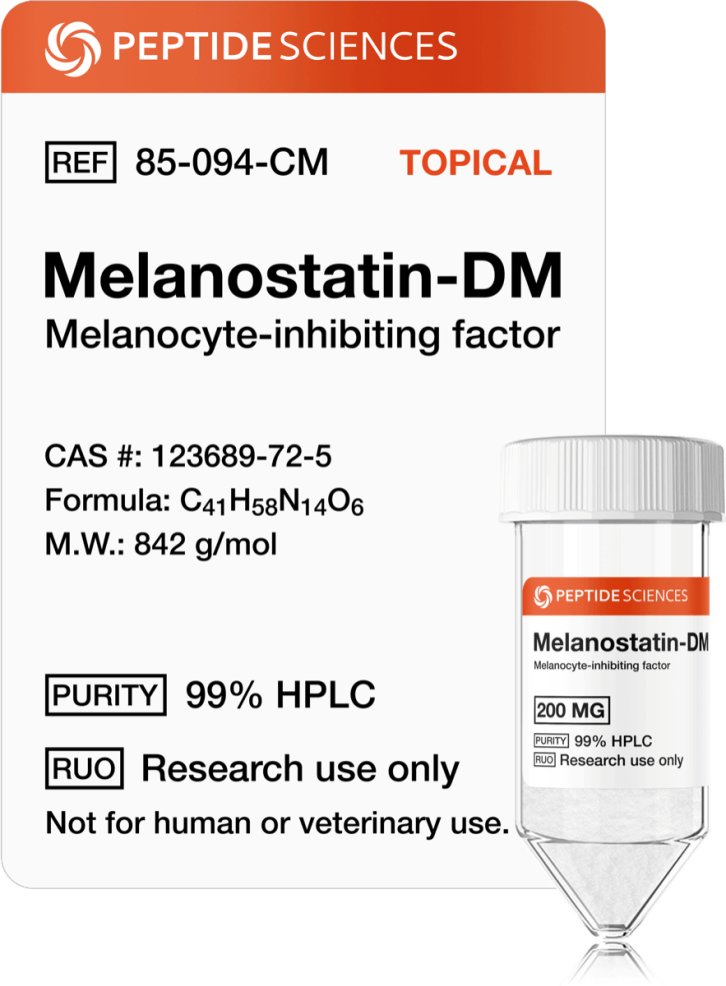
Melanostatin DM 200mg is an advanced synthetic tripeptide analog modeled after the endogenous Prolyl-Leucyl-Glycinamide (PLG) matrix. Engineered for topical dermal research, this 200mg configuration serves as a specialized biochemical tool for investigating $\alpha$-MSH modulation and the downregulation of melanogenesis pathways.
Melanostatin DM 200mg – Topical Research Peptide
Introduction to Melanostatin DM 200mg
Melanostatin DM 200mg is a synthetic hexapeptide research compound developed for controlled investigation of melanocortin signaling, α-melanocyte-stimulating hormone (α-MSH) antagonism, pigment-cell biology, and topical peptide formulation systems.
The research compound commonly known as melanostatin DM has the sequence:
H-His-D-Arg-Ala-Trp-D-Phe-Lys-NH₂
Its conformationally modified six-amino-acid architecture distinguishes it from endogenous melanostatin, also known as MIF-1 or Pro-Leu-Gly-NH₂, which is a separate naturally occurring tripeptide.
At USA PEPTIDE SCIENCES, melanostatin DM is supplied in a high-concentration 200mg topical research format for laboratories investigating melanocortin receptor systems, α-MSH-associated signaling, pigment-cell biology, peptide stability, and experimental formulation behavior.
For researchers studying melanostatin, this distinction between naturally occurring MIF-1 and the synthetic Melanostatin DM hexapeptide is essential for accurate experimental interpretation.
Melanostatin DM Research Overview
The primary scientific interest surrounding melanostatin DM comes from research examining its activity as an α-MSH antagonist in experimental pigment-cell systems.
The compound was originally designed as a hybrid analogue based on structural features from a growth hormone-releasing peptide analogue and an α-MSH fragment.
Experimental studies demonstrated α-MSH antagonistic activity in several vertebrate pigment models. However, responses varied substantially between species and experimental systems.
This makes melanostatin research particularly useful for examining:
- α-MSH-associated signaling
- Melanocortin receptor pharmacology
- Pigment-cell responses
- Receptor antagonism
- Model-dependent peptide activity
- Tyrosinase-associated pathways
- Melanogenesis research
- Topical peptide formulation
- Peptide stability and permeation models
Researchers can review melanostatin DM and α-MSH antagonist research on PubMed for peer-reviewed studies involving melanocortin signaling and pigment-cell biology.
Melanostatin vs Melanostatin DM
The terminology around melanostatin can easily cause confusion because two structurally different peptides are associated with the name.
Endogenous Melanostatin / MIF-1
The naturally occurring peptide historically called melanostatin is:
Pro-Leu-Gly-NH₂
It is also known as:
- PLG
- MIF-1
- Melanocyte-stimulating hormone release-inhibiting factor
- Oxytocin (7-9)
This endogenous peptide is a tripeptide.
Melanostatin DM
Melanostatin DM, by contrast, is the synthetic hexapeptide:
H-His-D-Arg-Ala-Trp-D-Phe-Lys-NH₂
It is therefore not simply the PLG sequence with one minor chemical modification.
Researchers working with melanostatin should keep these structures clearly separated when reviewing literature or designing experiments.
Melanostatin DM Compound Profile
- Compound: Melanostatin DM
- Sequence: H-His-D-Arg-Ala-Trp-D-Phe-Lys-NH₂
- Peptide length: 6 amino-acid residues
- Class: Synthetic α-MSH antagonist research peptide
- CAS number: 123689-72-5
- Molecular formula: C₄₁H₅₈N₁₄O₆
- Molecular weight: Approximately 843.0 g/mol
- Quantity: 200mg
- Format: Lyophilized topical research peptide
- Purity: ≥99% according to supplied specifications
- Analytical testing: HPLC and Mass Spectrometry
- Primary research areas: α-MSH signaling, melanocortin pharmacology, pigment-cell biology and topical formulation research
- Intended use: Laboratory and in-vitro research only
Melanostatin and α-MSH Antagonist Research
α-Melanocyte-stimulating hormone is an important signaling peptide within the melanocortin system.
Historical studies of the Melanostatin DM sequence demonstrated antagonism of α-MSH responses in several experimental vertebrate pigment systems.
For example, researchers observed inhibitory activity in certain lizard and amphibian pigment-cell models.
This makes melanostatin a useful research material for experiments examining:
- α-MSH receptor interactions
- Competitive antagonism
- Melanocortin signaling
- Pigment-cell responses
- Receptor pharmacology
- Concentration-dependent activity
However, the effect should not be described as universal.
Published comparative studies showed substantial differences between experimental species and found that the Melanostatin DM sequence was inactive as an α-MSH antagonist in the murine melanoma-cell system examined.
Melanostatin DM and Melanogenesis Research
Because α-MSH is involved in melanocortin signaling associated with pigment biology, melanostatin DM has attracted interest in experimental melanogenesis research.
Appropriate laboratory investigations may examine:
- α-MSH-induced signaling
- Melanocortin receptor activation
- Intracellular signaling downstream of pigment-associated receptors
- Tyrosinase-associated pathways
- Melanin-related cellular responses
- Receptor-antagonist concentration curves
- Model-specific pigmentation responses
The existing evidence does not justify claiming that melanostatin uniformly inhibits melanin synthesis across all human or mammalian systems.
Instead, the compound should be positioned as an experimental α-MSH antagonist whose activity may depend on receptor subtype, species, cell type, concentration, and assay conditions.
Melanostatin and Tyrosinase Pathway Research
Tyrosinase is a major enzyme involved in melanin biosynthesis.
Because α-MSH signaling can influence melanogenesis-associated pathways, researchers may investigate whether antagonism of upstream melanocortin signaling alters downstream tyrosinase expression or activity.
For melanostatin research, this provides an experimental framework for studying relationships among:
- α-MSH
- Melanocortin receptors
- cAMP-associated signaling
- Melanogenic transcription pathways
- Tyrosinase
- Melanin-associated cellular endpoints
These pathways represent research interests rather than established cosmetic effects of the USA Peptide Sciences product.
Melanostatin DM Topical Formulation Research
The 200mg topical research format makes melanostatin DM relevant to formulation-development studies.
Qualified laboratories may investigate:
- Peptide solubility
- Vehicle compatibility
- Hydrogel formulations
- Experimental emulsions
- Model-membrane permeation
- Concentration stability
- Light sensitivity
- Temperature stability
- Peptide-carrier interactions
- Experimental epidermal models
The term “topical” identifies the intended research and formulation category. It does not mean the supplied material is a finished skincare product or intended for personal application.
Melanostatin DM Quality Standards & Analytical Testing
At USA PEPTIDE SCIENCES, research-material consistency and reproducibility are central to our quality standards.
Each batch of Melanostatin DM 200mg Topical undergoes analytical quality-control testing according to the supplied specifications.
High-Performance Liquid Chromatography (HPLC) is used to confirm a stated purity profile of 99% or greater, while Mass Spectrometry (MS) supports molecular identity verification.
For laboratories investigating melanostatin, reliable analytical characterization is particularly important because receptor-antagonism experiments may be sensitive to concentration, peptide identity, and unwanted synthetic impurities.
A batch-specific Certificate of Analysis accompanies each order according to the supplied product information.
Melanostatin DM Storage and Handling
According to the supplied specifications, lyophilized melanostatin DM 200mg should be stored long-term at -20°C.
Experimental preparation should use an appropriate research-grade solvent or formulation vehicle selected according to the study design and compound compatibility.
Following preparation into solution, the supplied storage specification calls for refrigeration between 2°C and 8°C.
Researchers should minimize unnecessary exposure to heat and use gentle mixing procedures rather than aggressive mechanical agitation.
These instructions concern laboratory handling only and are not directions for human topical application.
Related Melanostatin Research Peptides
Researchers studying melanostatin, α-MSH pathways, pigment-cell signaling, or topical peptide systems may also explore:
- Melanostatin comparison – AHK-Cu Copper Tripeptide 200mg Topical — related topical peptide research material for comparative dermal and cellular studies.
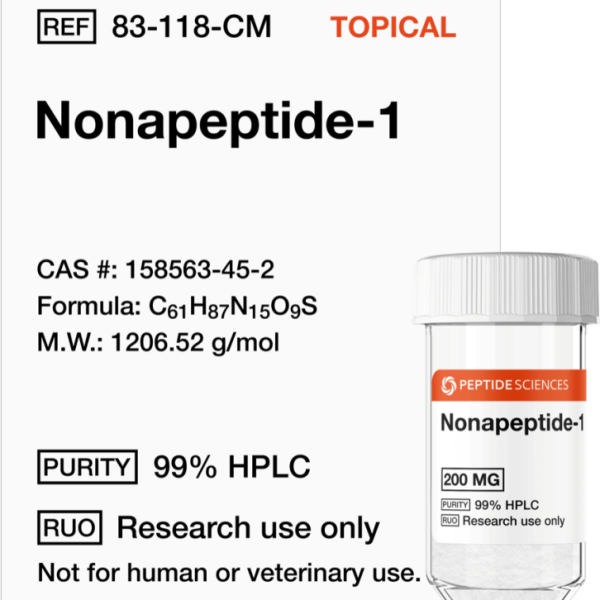
- Melanostatin comparison – Nonapeptide-1 200mg Topical — peptide commonly investigated in melanocortin and pigmentation-associated research models.
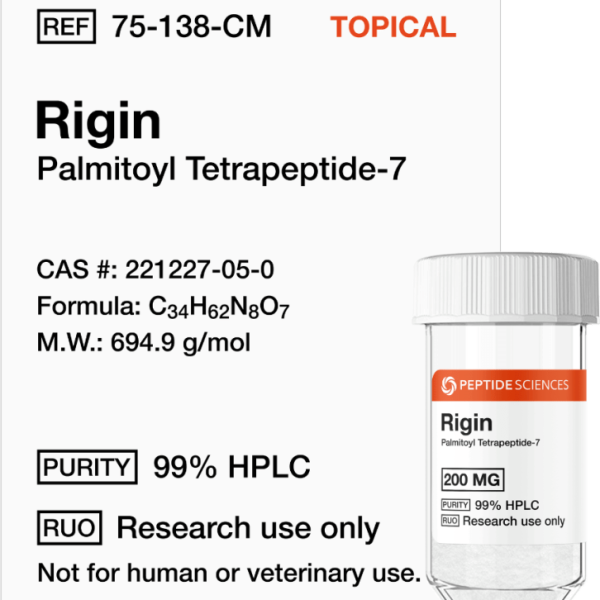
- Melanostatin comparison – Rigin Palmitoyl Tetrapeptide-7 200mg — related topical research peptide for comparative dermal-cell and formulation investigations.
Researchers can also review melanostatin and melanocortin research literature on PubMed for published studies involving α-MSH antagonists and pigment-cell signaling.
Melanostatin FAQ
What is melanostatin?
Melanostatin historically refers to the endogenous tripeptide Pro-Leu-Gly-NH₂, also known as MIF-1 or melanocyte-stimulating hormone release-inhibiting factor.
However, the product on this page is Melanostatin DM, a separate synthetic hexapeptide used in α-MSH antagonist research.
What is melanostatin DM?
Melanostatin DM is the synthetic hexapeptide:
H-His-D-Arg-Ala-Trp-D-Phe-Lys-NH₂
It has been studied experimentally as an α-MSH antagonist in several pigment-cell systems.
Is melanostatin DM the same as PLG?
No.
Native melanostatin/MIF-1 is the tripeptide Pro-Leu-Gly-NH₂ (PLG).
Melanostatin DM is a chemically distinct six-amino-acid peptide and should not be described as simply the PLG tripeptide.
What is the Melanostatin DM sequence?
The sequence is:
H-His-D-Arg-Ala-Trp-D-Phe-Lys-NH₂
How many amino acids are in Melanostatin DM?
Melanostatin DM contains six amino-acid residues, making it a hexapeptide.
What is the CAS number for Melanostatin DM?
The published registry number associated with the Melanostatin DM hexapeptide is 123689-72-5.
What is the molecular weight of Melanostatin DM?
The molecular weight is approximately 843.0 g/mol.
What is Melanostatin DM studied for?
Melanostatin DM is studied in laboratory research involving:
- α-MSH antagonism
- Melanocortin receptor pharmacology
- Pigment-cell signaling
- Melanogenesis-associated pathways
- Tyrosinase-associated research
- Peptide formulation
- Model-membrane permeation
- Receptor response variability
Does melanostatin block α-MSH?
The Melanostatin DM hexapeptide has shown α-MSH antagonistic activity in several experimental pigment models.
However, the effect is not universal across every biological system, so it is more accurate to describe it as an experimentally studied α-MSH antagonist rather than claiming complete or universal blockade.
Does melanostatin DM inhibit melanin production?
Research has examined Melanostatin DM through α-MSH and pigmentation-associated pathways.
Its effects vary by experimental model, and published comparative research found that the peptide did not act as an α-MSH antagonist in every cell system tested.
It should therefore not be described as universally suppressing melanin production.
Is melanostatin DM studied for tyrosinase?
It may be investigated in experiments examining downstream melanogenesis pathways, including tyrosinase-associated endpoints.
Any effect on tyrosinase should be evaluated experimentally rather than assumed from α-MSH antagonism alone.
Is melanostatin DM a topical cosmetic?
No.
The USA Peptide Sciences melanostatin DM 200mg product is supplied as laboratory research material.
“Topical” refers to the formulation-research category and does not mean the peptide is a finished cream, serum, cosmetic treatment, or consumer product.
What purity is melanostatin DM 200mg?
According to the supplied specifications, Melanostatin DM 200mg has a purity profile of 99% or greater, with HPLC and Mass Spectrometry used for analytical verification.
Does Melanostatin DM include a Certificate of Analysis?
Yes. According to the supplied product information, each order includes batch-specific Certificate of Analysis documentation.
How should melanostatin DM be stored?
According to the supplied specifications, melanostatin DM should be stored at -20°C while lyophilized.
Following preparation into solution for controlled laboratory work, the supplied specification calls for storage between 2°C and 8°C.
What other topical peptides can researchers compare with melanostatin?
Researchers studying melanostatin can compare it with AHK-Cu 200mg Topical, Nonapeptide-1 200mg Topical, and Rigin Palmitoyl Tetrapeptide-7 200mg in appropriately designed laboratory studies.
Can researchers find melanostatin studies on PubMed?
Yes.
Researchers can review melanostatin DM and α-MSH antagonist research on PubMed for studies involving the H-His-D-Arg-Ala-Trp-D-Phe-Lys-NH₂ sequence, melanocortin pharmacology, α-MSH antagonism, and pigment-cell biology.
Is melanostatin intended for human use?
No.
Melanostatin DM 200mg supplied by USA Peptide Sciences is designated strictly for laboratory and in-vitro research.
It is not intended for human or veterinary consumption, personal topical application, skin-lightening use, treatment of hyperpigmentation, incorporation into finished commercial cosmetics, therapeutic administration, or clinical diagnostics.
Melanostatin DM 200mg Research Use Disclaimer
The Melanostatin DM 200mg Topical material distributed by USA PEPTIDE SCIENCES is designated strictly for laboratory research purposes only.
The term melanostatin throughout this page refers to the scientific research context surrounding Melanostatin DM and related melanocortin signaling systems.
This product is not intended for human or veterinary consumption, personal topical application, cosmetic pigmentation modification, inclusion in finished consumer cosmetics, therapeutic drug administration, direct clinical diagnostics, or treatment of any disease or condition.
All handling, measurement, formulation development, and experimental evaluation must be conducted exclusively by qualified scientific professionals within an appropriate controlled research environment.
Camryn –
Katelin –
I had a fairly disappointing experience with this purchase. The website was easy to use and I received my order within a reasonable timeframe, but when I reconstituted the Melanostatin DM, I noticed that the powder did not fully dissolve even after thorough mixing, leaving some tiny particulate matter that I was concerned about applying to my skin. I reached out to support and they suggested adjusting the pH, but it was inconvenient and left me questioning the quality. As for the results, I used the product for several weeks and honestly cannot say I noticed any real difference in my hyperpigmentation, dark spots, or overall skin tone. I understand that Melanostatin DM works as an α-MSH antagonist , but the lack of any noticeable benefits in my case was disappointing. I might try a different vendor or a different brightening ingredient next time because this just did not work for me.
Marianne –
This was my first time using a targeted skin lightening peptide and I could not be happier with the experience. The customer support team walked me through the reconstitution process, explaining that this hexapeptide with sequence His-D-Arg-Ala-Trp-D-Phe-Lys-NH₂ is specifically designed to block α-MSH from binding to melanocortin receptors . Shipping was lightning fast and the packaging was professional with clear handling instructions. I have been using it for about 5 weeks and the improvements in my skin are genuinely impressive. My post-inflammatory hyperpigmentation has faded noticeably, and my overall complexion looks brighter and more uniform. The research showing Melanostatin DM reduces melanin production without affecting melanocyte viability is clearly translating into real-world results for me .