
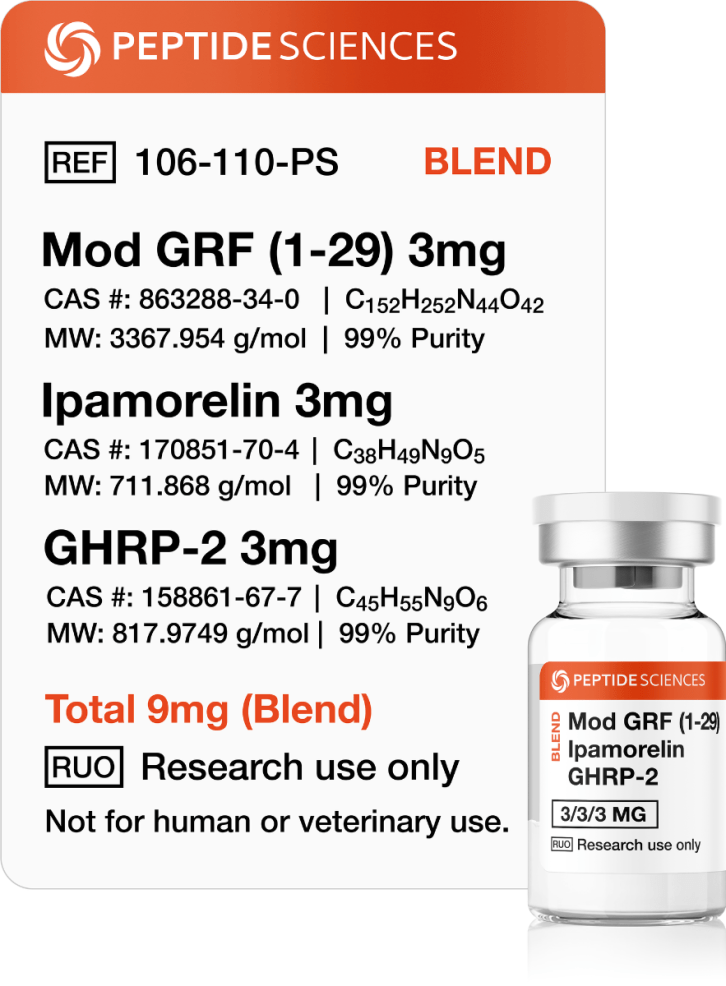
Mod GRF Peptide, Ipamorelin, GHRP-2 (Blend)
$95.00
PRODUCT SHORT DESCRIPTION
The Mod GRF, Ipamorelin & GHRP-2 research blend integrates three distinct growth hormone secretagogues to model multi-receptor regulation within the somatotropic axis. This formulation provides a comprehensive biochemical tool for investigating maximum growth hormone pulsatility and receptor signaling crosstalk.
Mod GRF Peptide, Ipamorelin & GHRP-2 Research Blend
WooCommerce Short Product Description
- Mod GRF peptide multi-compound research formulation
- Contains Modified GRF (1-29), Ipamorelin and GHRP-2
- Mod GRF class: 29-amino-acid GHRH analogue
- Ipamorelin class: Selective synthetic growth hormone secretagogue
- GHRP-2 class: Synthetic hexapeptide growth hormone secretagogue
- Primary receptor systems: GHRH receptor and GHS-R-associated pathways
- Research focus: Somatotroph signaling, receptor cross-talk and secretagogue pharmacology
- Form: Uniform lyophilized research blend
- Purity: ≥99% according to supplied specifications
- Testing: HPLC and Mass Spectrometry
- Strictly for laboratory and in-vitro research only
Introduction to the Mod GRF Peptide Research Matrix
The Mod GRF, Ipamorelin & GHRP-2 Blend represents an advanced multi-component peptide matrix designed for controlled studies involving endocrinology, cellular signaling and somatotropic-axis regulation.
This formulation combines one mod grf peptide acting through the growth hormone-releasing hormone receptor with two structurally distinct growth hormone secretagogues—Ipamorelin and GHRP-2—that act through the growth hormone secretagogue receptor system.
At USA PEPTIDE SCIENCES, the three compounds are supplied together as a single uniform lyophilized research matrix for qualified laboratory investigation.
Rather than describing the formulation as three completely independent receptor pathways, it is more technically accurate to describe it as a three-peptide, dual-receptor-system research platform.
For scientists studying mod grf peptide signaling, the inclusion of two different GHS-associated agonists provides an opportunity to compare GHRH-receptor activation with distinct secretagogue pharmacology within the same experimental matrix.
Mod GRF Peptide Research Overview
The principal research value of this formulation comes from the convergence of GHRH-associated signaling with growth hormone secretagogue receptor pathways.
Native growth hormone secretion is influenced by several interacting endocrine signals, including:
- Growth hormone-releasing hormone
- Growth hormone secretagogues and ghrelin-associated signaling
- Somatostatin
- Pituitary feedback systems
- Peripheral GH/IGF-1-associated pathways
Published human and preclinical research has demonstrated that GHRH and GHRP pathways can interact synergistically under certain experimental conditions.
A mod grf peptide research blend containing Ipamorelin and GHRP-2 therefore provides a platform for investigating:
- GHRH receptor activation
- GHS-R-associated signaling
- cAMP-mediated pathways
- Calcium and phospholipase-associated signaling
- Somatotroph secretory responses
- Secretagogue selectivity
- Receptor cross-talk
- Somatostatin-associated regulation
- GH-associated gene-expression models
- IGF-1-axis research
Researchers can review Mod GRF peptide, GHRP-2 and growth hormone secretagogue research on PubMed for peer-reviewed literature involving these pathways.
Mod GRF Peptide / Modified GRF 1-29
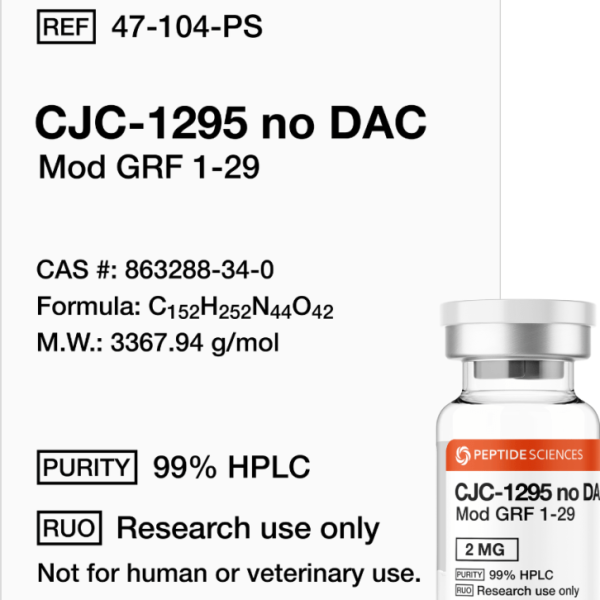
The mod grf peptide component is more precisely known as Modified GRF (1-29).
It is a synthetic 29-amino-acid analogue of the biologically active N-terminal region of endogenous growth hormone-releasing hormone.
Modified GRF (1-29) contains four amino-acid substitutions relative to native GHRH (1-29), commonly described at positions:
- 2
- 8
- 15
- 27
These substitutions were developed to improve resistance to rapid enzymatic degradation while preserving GHRH-receptor-associated activity.
The compound is frequently marketed under names including:
- Mod GRF
- Mod GRF 1-29
- ModGRF
- Modified GRF 1-29
- CJC-1295 No DAC
- CJC-1295 without DAC
Mod GRF 1-29 vs CJC-1295 With DAC
The terminology surrounding mod grf peptide products is frequently inconsistent.
Original CJC-1295 includes a Drug Affinity Complex (DAC) designed to support albumin binding and prolonged systemic persistence.
Modified GRF (1-29), commonly marketed as CJC-1295 No DAC, does not contain that albumin-binding DAC moiety.
For this reason, the two structures should not be treated as pharmacokinetically identical.
The phrase “CJC-1295 No DAC” is retained because it is widely used in the research market, but Modified GRF (1-29) is the more precise structural designation for the no-DAC 29-amino-acid peptide.
Mod GRF Peptide and GHRH-Receptor Signaling
GHRH receptors on pituitary somatotrophs are associated with intracellular signaling involving adenylyl cyclase and cyclic AMP.
Researchers studying a mod grf peptide may therefore investigate:
- GHRH-receptor binding
- cAMP accumulation
- Protein kinase-associated signaling
- Somatotroph activation
- Receptor sensitivity
- Secretory kinetics
- Receptor desensitization
- GH gene-expression responses
These mechanisms provide the GHRH-associated signaling arm of the three-compound research matrix.
Ipamorelin Research Component
Ipamorelin is a synthetic pentapeptide commonly represented as:
Aib-His-D-2-Nal-D-Phe-Lys-NH₂
Ipamorelin has been characterized in preclinical research as a selective growth hormone secretagogue.
In comparative animal studies, Ipamorelin stimulated GH release while producing much less ACTH and cortisol activation than GHRP-2 or GHRP-6 under the experimental conditions studied.
Within the mod grf peptide blend, Ipamorelin provides one GHS-associated signaling component for comparison with the broader secretagogue activity of GHRP-2.
Research interests may include:
- GHS receptor signaling
- GH secretagogue selectivity
- Calcium-associated exocytosis
- ACTH-associated responses
- Cortisol-associated pathways
- Comparative secretagogue potency
These findings are preclinical and should not be interpreted as human safety or endocrine-benefit claims.
GHRP-2 / Pralmorelin Research Component
GHRP-2, also known as Pralmorelin, is a synthetic hexapeptide represented as:
D-Ala-D-2-Nal-Ala-Trp-D-Phe-Lys-NH₂
It is a potent growth hormone secretagogue studied through GHS-receptor-associated pathways.
Published comparative research has shown GHRP-2 to produce robust growth hormone secretagogue activity, while also producing ACTH and cortisol responses under some experimental conditions.
This makes GHRP-2 useful when comparing the pharmacological selectivity of different secretagogues within a mod grf peptide research system.
GHRP-2 Research Areas
Laboratories may examine:
- GHS-R-associated signaling
- Somatotroph activation
- GH-release kinetics
- ACTH-associated pathways
- Cortisol-associated pathways
- Secretagogue potency
- Receptor desensitization
- GHRH/GHRP interaction
Mod GRF Peptide and GHRP-2 Synergy Research
Published research supports a synergistic relationship between GHRH and GHRP-2 under specific experimental conditions.
Human studies have shown that combined administration of GHRH and GHRP-2 can stimulate pulsatile GH secretion more strongly than either pathway alone.
In-vitro research has also demonstrated direct effects of GHRH and GHRP-2 on:
- GH secretion
- GHRH-receptor expression
- GHS-receptor expression
- Pituitary transcription factor-1
- Somatostatin-receptor expression
This provides a legitimate mechanistic basis for investigating interaction between mod grf peptide and GHRP-2 signaling.
However, the exact USA Peptide Sciences three-compound blend has not been shown here to produce a predefined or universally supra-additive response.
Experimental results will depend on:
- Model system
- Relative component concentrations
- Exposure duration
- Receptor expression
- Somatostatin tone
- Cellular state
- Assay conditions
Does Adding Ipamorelin Create a Third Receptor Pathway?
Not exactly.
Ipamorelin and GHRP-2 are chemically distinct secretagogues, but both belong to the GHS-receptor-associated pharmacological class.
Therefore, adding Ipamorelin to mod grf peptide and GHRP-2 creates three separate molecular components but not three wholly independent receptor classes.
The formulation is better suited to research examining:
- One GHRH-receptor agonist
- Two structurally distinct GHS-associated agonists
- Ligand competition
- Secretagogue selectivity
- Receptor occupancy
- Signaling convergence
- Concentration-dependent response profiles
Mod GRF Peptide and Somatostatin Research
Somatostatin is a major inhibitory regulator of pituitary GH secretion.
The relationship between GHRPs and somatostatin is complex.
GHRP-2 has been studied in systems where somatostatin receptor signaling substantially alters GH responses. Other experiments have also reported changes in somatostatin-receptor expression following GHRP-2 exposure.
It is therefore more accurate to describe the mod grf peptide blend as a tool for investigating interactions with somatostatinergic regulation rather than claiming that Ipamorelin or GHRP-2 simply suppress somatostatin.
Mod GRF Peptide Research Specifications
| Property | Specification |
|---|---|
| Product | Mod GRF, Ipamorelin & GHRP-2 Blend |
| Mod GRF component | Modified GRF (1-29) |
| Mod GRF length | 29 amino acids |
| Mod GRF class | Synthetic GHRH analogue |
| Ipamorelin class | Synthetic pentapeptide growth hormone secretagogue |
| Ipamorelin sequence | Aib-His-D-2-Nal-D-Phe-Lys-NH₂ |
| GHRP-2 alternative name | Pralmorelin |
| GHRP-2 class | Synthetic hexapeptide growth hormone secretagogue |
| GHRP-2 sequence | D-Ala-D-2-Nal-Ala-Trp-D-Phe-Lys-NH₂ |
| Primary receptor systems | GHRH receptor and GHS-R-associated pathways |
| Form | Uniform lyophilized research blend |
| Purity | ≥99% according to supplied specifications |
| Testing | HPLC and Mass Spectrometry |
| Documentation | Batch-specific Certificate of Analysis |
| Intended use | Laboratory and in-vitro research only |
Blend Quantity Clarification
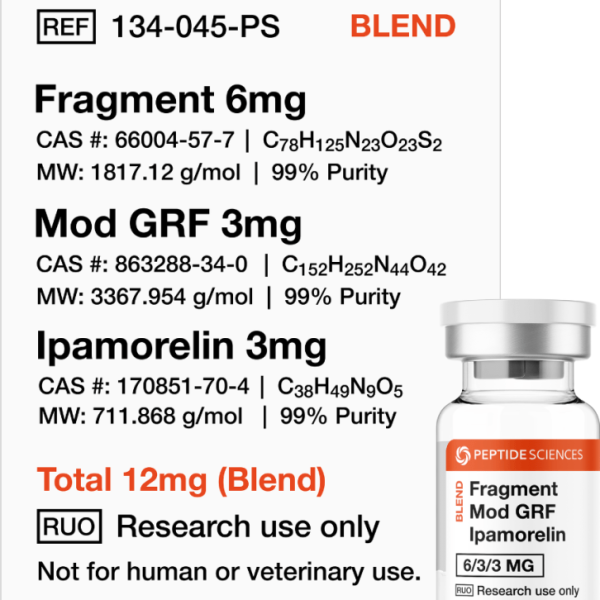
A total blend quantity and individual component ratio were not provided in the supplied product information.
For that reason, this page does not invent or assume a 1:1:1 ratio or a specific milligram quantity for any individual component.
Batch-specific composition should be taken from the product label and corresponding Certificate of Analysis.
Mod GRF Peptide Quality Standards & Analytical Testing
At USA PEPTIDE SCIENCES, compound identity and experimental reproducibility are central to research-material quality.
Every production lot of the Mod GRF, Ipamorelin and GHRP-2 formulation undergoes analytical evaluation according to the supplied specifications.
High-Performance Liquid Chromatography (HPLC) is used to support purity assessment, while Mass Spectrometry (MS) supports molecular identity verification.
The supplied specification states 99% or greater purity for the peptide material.
Researchers working with a mod grf peptide multi-component system should pay particular attention to batch-specific documentation because analytical verification of a mixture is more complex than characterization of a single isolated peptide.
A batch-specific Certificate of Analysis accompanies each order according to the supplied information.
Mod GRF Peptide Storage and Handling Requirements
According to the supplied product specifications, the lyophilized mod grf peptide, Ipamorelin and GHRP-2 blend should be stored long-term at -20°C.
Prior to controlled laboratory experimentation, preparation may be performed using an appropriate sterile, non-pyrogenic or bacteriostatic research diluent compatible with the assay.
Following research reconstitution, the supplied storage specification calls for refrigeration between 2°C and 8°C.
Researchers should use gentle swirling during dissolution and avoid aggressive mechanical agitation or shaking.
These instructions concern laboratory preparation only and are not human administration guidance.
Related Mod GRF Peptide Research Compounds
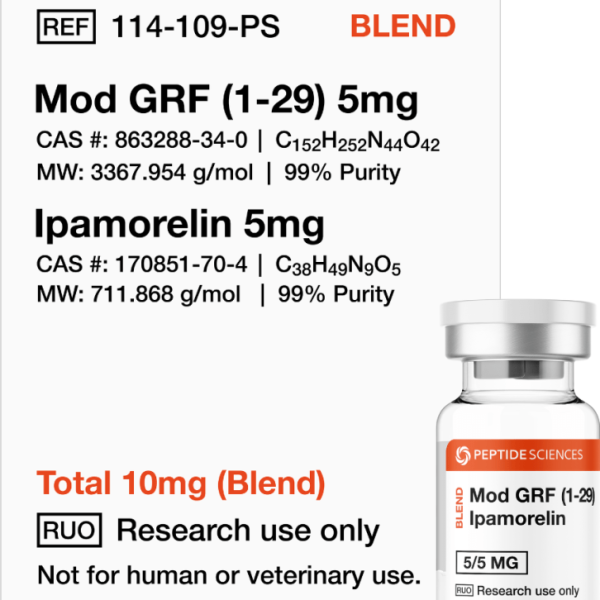
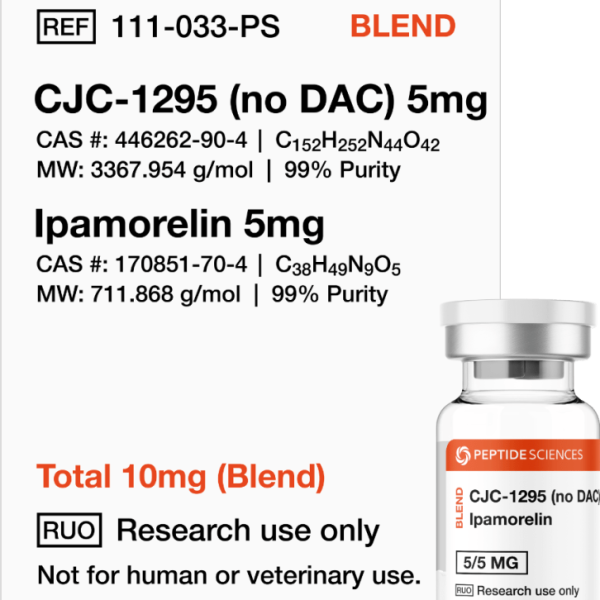
Researchers studying mod grf peptide signaling can compare the three-compound matrix with the CJC-1295 No DAC Modified GRF 1-29 + Ipamorelin 10mg Blend to examine a simpler GHRH/GHS dual-compound configuration.
Researchers can also browse the USA Peptide Sciences growth hormone research peptide catalogue for CJC-1295 No DAC, GHRP-2 and other comparative secretagogue research materials.
For external scientific literature, review Mod GRF peptide, GHRP-2 and Ipamorelin research on PubMed.
Mod GRF Peptide FAQ
What is mod grf peptide?
Mod GRF peptide is a modified 29-amino-acid analogue of GHRH (1-29) designed to retain GHRH-receptor-associated activity while improving resistance to rapid enzymatic degradation.
It is also commonly called Modified GRF (1-29), Mod GRF 1-29 or CJC-1295 No DAC.
What is Mod GRF 1-29?
Mod GRF 1-29 is a tetrasubstituted analogue of the biologically active first 29 amino acids of human GHRH.
It is designed for research involving GHRH receptors, pituitary somatotrophs and cAMP-associated signaling.
What does modgrf mean?
ModGRF is simply a condensed spelling of Modified Growth Hormone-Releasing Factor.
In research-product terminology, modgrf usually refers to Modified GRF (1-29).
Is Mod GRF the same as CJC-1295 No DAC?
In the research-supplier market, Mod GRF 1-29 is commonly sold under the name CJC-1295 No DAC.
However, original CJC-1295 was developed with a Drug Affinity Complex.
For precise scientific writing, Modified GRF (1-29) is the preferred designation for the short 29-amino-acid no-DAC structure.
Is Mod GRF 1-29 the same as CJC-1295 with DAC?
No.
Mod GRF 1-29 lacks the albumin-binding DAC modification found in original CJC-1295.
The compounds therefore have different structures and pharmacokinetic characteristics.
What is mod grf peptide studied for?
Mod grf peptide is investigated in laboratory research involving:
- GHRH-receptor signaling
- cAMP pathways
- Somatotroph biology
- GH-associated signaling
- Secretagogue interactions
- Receptor cross-talk
- GHRH/GHRP synergy
- Neuroendocrine feedback
Why combine Mod GRF with Ipamorelin?
Combining mod grf peptide with Ipamorelin allows researchers to examine GHRH-receptor-associated signaling alongside a selective GHS-associated secretagogue pathway.
Researchers can compare this mechanism directly using the CJC-1295 No DAC + Ipamorelin research blend.
Why combine Mod GRF with GHRP-2?
Published research demonstrates interaction and synergy between GHRH and GHRP-2 signaling under specific experimental conditions.
This makes the combination useful for investigating convergent pituitary signaling and somatotroph responses.
Why are Ipamorelin and GHRP-2 both included?
Ipamorelin and GHRP-2 are chemically distinct secretagogues with different selectivity profiles.
Comparing them in the same research matrix may help investigators study differences in potency, receptor signaling and secondary endocrine responses.
Is this really a triple-pathway blend?
It contains three peptides, but describing it as three completely independent receptor pathways would be misleading.
The mod grf peptide targets the GHRH receptor, while Ipamorelin and GHRP-2 both belong to the GHS-receptor-associated secretagogue class.
It is better described as a three-compound, dual-receptor-system research matrix.
Is Ipamorelin more selective than GHRP-2?
In published preclinical studies, Ipamorelin demonstrated greater selectivity for GH-associated signaling, while GHRP-2 also produced measurable ACTH and cortisol responses in the experimental animal systems studied.
These findings should not be generalized into human safety claims.
Does GHRP-2 increase cortisol?
GHRP-2 has produced increased ACTH and cortisol levels in some preclinical and human research conditions.
The extent of this response depends on experimental context.
Does this blend suppress somatostatin?
It is more accurate to say that GHRP signaling interacts with somatostatinergic regulation.
Research does not justify describing the entire blend as a simple somatostatin blocker.
What is the difference between Mod GRF and GHRP-2?
Mod GRF is a GHRH analogue acting through the GHRH receptor.
GHRP-2 is a synthetic growth hormone secretagogue acting through GHS-receptor-associated pathways.
The different receptor systems provide the biological rationale for studying them together.
What is the difference between Ipamorelin and GHRP-2?
Both are growth hormone secretagogues, but they have distinct molecular structures and pharmacological profiles.
Ipamorelin demonstrated greater GH selectivity in classic preclinical comparisons, whereas GHRP-2 produced broader endocrine responses under some experimental conditions.
What does buy Mod GRF 1-29 mean?
The phrase buy mod grf 1-29 generally refers to obtaining Modified GRF (1-29) for laboratory research.
USA Peptide Sciences materials are supplied strictly for qualified scientific investigation and not human administration.
What does buy CJC-1295 No-DAC Mod GRF 1-29 mean?
The phrase buy cjc-1295 no-dac mod grf 1-29 reflects the multiple names commonly used for the same no-DAC research peptide category.
The phrase concerns laboratory-material sourcing and should not be interpreted as dosing or human-use guidance.
Is a human dosage provided for Mod GRF 1-29?
No.
USA Peptide Sciences does not provide human dosing protocols for mod grf peptide, Ipamorelin or GHRP-2.
Experimental concentrations should be determined by qualified investigators according to the specific in-vitro or preclinical research design.
What purity is the blend?
According to the supplied specifications, the formulation is produced using peptide material with a stated purity of 99% or greater, with HPLC and Mass Spectrometry used for analytical evaluation.
Does the blend include a Certificate of Analysis?
Yes.
According to the supplied product information, a batch-specific Certificate of Analysis accompanies each order.
How should Mod GRF, Ipamorelin and GHRP-2 be stored?
According to the supplied specifications, the lyophilized research material should be stored at -20°C.
Following controlled laboratory preparation into solution, the stated storage range is 2°C to 8°C.
Where can researchers find Mod GRF peptide research?
Researchers can review Mod GRF peptide, GHRH, GHRP-2 and Ipamorelin literature on PubMed for studies involving GHRH/GHRP signaling, secretagogue pharmacology, somatostatin regulation and pituitary biology.
Is Mod GRF peptide intended for human use?
No.
The mod grf peptide, Ipamorelin and GHRP-2 blend supplied by USA Peptide Sciences is designated strictly for laboratory and in-vitro scientific research.
It is not intended for human or veterinary consumption, hormone enhancement, bodybuilding, athletic performance, therapeutic administration or clinical diagnostics.
Mod GRF Peptide Research Use Disclaimer
The Mod GRF, Ipamorelin & GHRP-2 Blend distributed by USA PEPTIDE SCIENCES is intended strictly for laboratory research purposes only.
The phrase mod grf peptide throughout this page refers exclusively to Modified GRF (1-29) and its role in controlled scientific research.
This formulation is not intended for human or veterinary consumption, hormone replacement, bodybuilding, athletic-performance enhancement, anti-aging use, therapeutic administration, direct clinical diagnostics or treatment of any disease or condition.
All handling, measurement and experimental evaluation must be performed exclusively by qualified scientific professionals within an appropriate controlled research environment.
Elenora –
Darius –
Ordering was straightforward and the vendor provided clear documentation for this triple-peptide research blend. The combination of Mod GRF (a stabilized GHRH analog) with Ipamorelin and GHRP-2 (two ghrelin receptor agonists) offers a complementary pathway approach—Mod GRF primes GH synthesis through the GHRH receptor, while both GHRPs trigger exocytosis through GHS-R1a, producing amplified GH output through convergent signaling . I observed robust GH pulse amplification in my research models that exceeded the effects of any individual component.
Norene –
I’ve been following the GH secretagogue literature and this triple blend was exactly what I needed. The distinct GHRP components offer complementary receptor engagement profiles—Ipamorelin provides selective GH release without cortisol/prolactin elevation, while GHRP-2 engages broader hypothalamic circuits . Shipping was prompt with a COA. I observed consistent results in my pituitary signaling studies. The triple design produces a more complete picture of GH axis modulation.
Bailee –
Support was proactive with handling guidance—the blend reconstituted cleanly. The simultaneous activation of cAMP/PKA and PLC/PKC pathways provides a comprehensive model for studying somatotroph signaling . The 10mg format is excellent value for research applications.
Ona –
I’m uncertain this triple blend lived up to expectations. Ordering was fine but support gave a generic response when I asked about the specific evidence base for the triple combination. I used it for several weeks and observed results that were less consistent than the synergy literature suggested. The GHRP-2 addition creates a “dated, non-selective” component—it releases GH but also raises cortisol, prolactin, and appetite, which complicates research outcomes . For researchers requiring selective GH pathway stimulation, the Mod GRF/Ipamorelin pair is the cleaner option.