
BPC 157 Oral 500mcg (60 Capsules)
$348.00
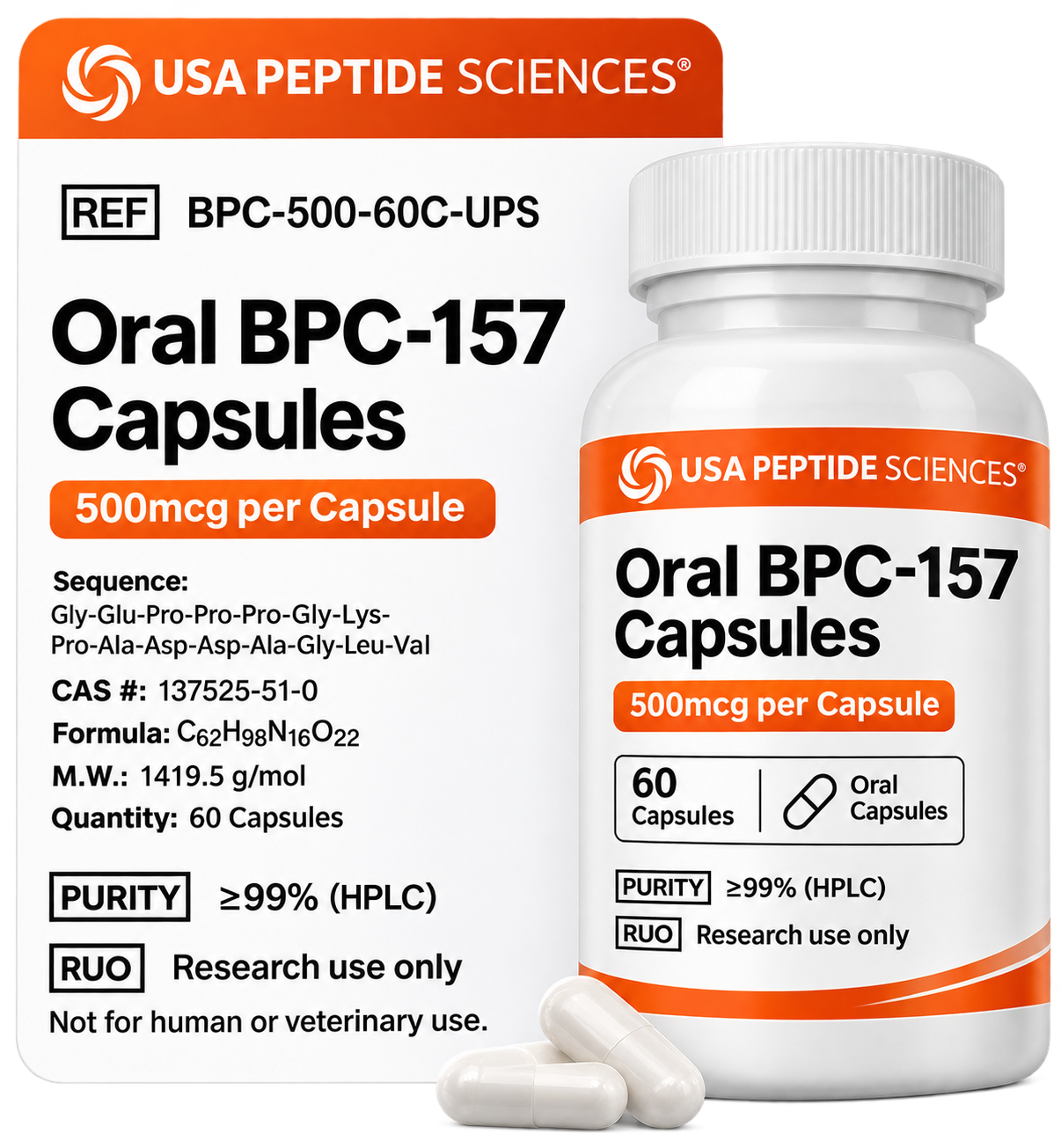
- BPC 157 oral research capsules
- 500mcg BPC-157 per capsule
- 60 capsules per bottle
- Total labeled BPC-157 content: 30mg per bottle
- Synthetic 15-amino-acid pentadecapeptide
- Sequence: Gly-Glu-Pro-Pro-Pro-Gly-Lys-Pro-Ala-Asp-Asp-Ala-Gly-Leu-Val
- One-letter sequence: GEPPPGKPADDAGLV
- Research focus: gastric stability, GI models, epithelial signaling, endothelial pathways and oral peptide formulation
- Encapsulated laboratory research format
- Strictly for laboratory and in-vitro research only
- Not intended for human or veterinary consumption
BPC 157 Oral 500mcg Capsules – Laboratory Research Format
Introduction to BPC 157 Oral Research Capsules
BPC 157 oral research capsules provide the synthetic pentadecapeptide BPC-157 in a standardized encapsulated format containing 500mcg per capsule and 60 capsules per bottle.
BPC-157 consists of 15 amino acids:
Gly-Glu-Pro-Pro-Pro-Gly-Lys-Pro-Ala-Asp-Asp-Ala-Gly-Leu-Val
One-letter sequence:
GEPPPGKPADDAGLV
BPC-157 is frequently described in published literature as a stable gastric pentadecapeptide because experimental work has reported stability in human gastric juice.
This characteristic has made the peptide particularly interesting for research involving gastrointestinal environments and alternative formulation routes.
At Peptide Science, the capsule format is supplied strictly for laboratory investigation of peptide stability, gastrointestinal interactions and related biological pathways.
The capsule format does not establish human oral bioavailability or constitute an instruction for oral consumption.
BPC-157 Technical Specifications
| Property | Specification |
|---|---|
| Compound | BPC-157 |
| Sequence | Gly-Glu-Pro-Pro-Pro-Gly-Lys-Pro-Ala-Asp-Asp-Ala-Gly-Leu-Val |
| One-letter sequence | GEPPPGKPADDAGLV |
| Peptide length | 15 amino acids |
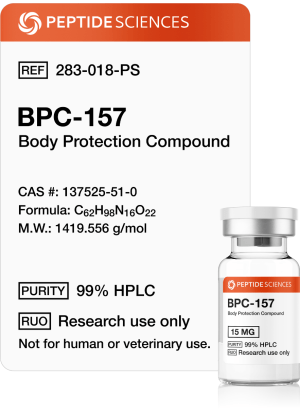
| Molecular formula | C62H98N16O22 |
| Molecular weight | Approximately 1419.5 g/mol |
| CAS number | 137525-51-0 |
| Capsule content | 500mcg BPC-157 |
| Capsule count | 60 |
| Total labeled peptide | 30mg |
| Format | Encapsulated research material |
| Research category | Gastric pentadecapeptide |
| Intended use | Laboratory research only |
Researchers can consult PubChem for additional chemical reference information relating to BPC-157.
BPC 157 Oral Stability Research
One of the major reasons bpc 157 oral research attracts interest is the unusual gastric stability reported for the peptide.
Published reviews have described BPC-157 as stable in human gastric juice and have investigated the peptide extensively in gastrointestinal models.
This distinguishes it from many peptides that are rapidly degraded under acidic or proteolytic conditions.
Researchers may investigate:
- Peptide integrity under low-pH conditions
- Simulated gastric-fluid stability
- Proteolytic resistance
- Capsule disintegration
- Gastrointestinal exposure
- Peptide recovery following incubation
- Comparative formulation stability
Stability, however, should not be confused with proven systemic bioavailability.
A peptide can remain chemically intact in a gastrointestinal environment without necessarily demonstrating efficient absorption across the intestinal epithelium.
Does Oral BPC 157 Work?
The search phrase does oral bpc 157 work requires an important scientific distinction.
Preclinical literature includes studies in which BPC-157 was administered perorally to animals.
Those experiments have reported biological responses in gastrointestinal and other research models.
However, current human evidence is extremely limited.
FDA’s 2026 evaluation reported that it found no human studies administering BPC-157 by the oral route among the data reviewed.
Therefore, the available evidence does not establish:
- Human oral bioavailability
- A validated oral absorption percentage
- A human oral pharmacokinetic profile
- An approved oral dosing regimen
- Clinical effectiveness of oral BPC-157
For this reason, Peptide Science describes bpc 157 oral capsules strictly as an encapsulated research format.
BPC 157 Oral and Gastrointestinal Research
The gastrointestinal system represents one of the most extensively studied areas for BPC-157.
Preclinical investigations have examined the peptide in models involving:
- Gastric mucosa
- Intestinal tissue
- Experimental ulceration
- Intestinal anastomoses
- Fistula models
- Mucosal integrity
- Epithelial signaling
- Endothelial responses
Peroral BPC-157 has been used in several animal gastrointestinal studies.
This provides a scientific basis for investigating the capsule format in gastrointestinal research while avoiding unsupported claims about human treatment.
BPC-157 and Gastric Mucosal Research
BPC-157 research originated largely from investigations into gastric cytoprotection.
Published studies and reviews have examined its interaction with gastric and intestinal tissues under experimentally induced injury conditions.
Researchers may evaluate endpoints such as:
- Epithelial integrity
- Tissue morphology
- Mucosal signaling
- Cellular migration
- Vascular responses
- Extracellular-matrix markers
These findings remain largely preclinical.
The bpc 157 oral product should not be described as a treatment for ulcers, inflammatory bowel disease, “leaky gut,” or another gastrointestinal condition.
BPC-157 and Tight-Junction Research
The intestinal epithelial barrier relies on tight-junction proteins and related structural complexes.
BPC-157 has been investigated in experimental models involving disruption of intestinal barrier integrity.
Researchers may examine markers including:
- Zonula occludens proteins
- Junctional integrity
- Epithelial permeability
- Cellular morphology
- Barrier-associated signaling
However, the available evidence does not justify presenting bpc 157 oral capsules as proven to repair intestinal permeability in humans.
“Leaky gut treatment” terminology should therefore be avoided.
BPC-157 and Angiogenesis Research
BPC-157 has been studied in relation to angiogenesis and endothelial signaling.
Research has examined pathways involving:
- VEGF-associated signaling
- Endothelial-cell migration
- Vascular recruitment
- Collateral-vessel development
- Tissue vascularization
These experimental findings are relevant to gastrointestinal and broader tissue models.
They do not establish that oral capsules produce systemic angiogenesis or tissue repair in humans.
BPC-157 and Nitric Oxide Research
The nitric-oxide system is another important area of BPC-157 investigation.
Studies have reported interactions among BPC-157 and:
- Nitric-oxide signaling
- NOS-associated pathways
- Endothelial function
- Vascular responses
- Vasomotor regulation
The evidence indicates a complex modulatory relationship.
For accuracy, BPC-157 should not be described as simply increasing or decreasing nitric oxide under every condition.
Researchers using bpc 157 oral capsules may instead treat nitric-oxide-associated pathways as experimental endpoints.
BPC-157 and the Gut-Brain Axis
Research has also examined BPC-157 in relation to several neurotransmitter-associated systems.
Published preclinical literature has discussed possible relationships involving:
- Dopamine-associated signaling
- Serotonergic pathways
- Central nervous system responses
- Gastrointestinal-brain interactions
These findings remain mechanistically complex.
BPC-157 does not currently have a sufficiently established molecular profile to claim a defined human gut-brain-axis effect from oral administration.
Oral BPC 157 vs Injection
The keyword oral bpc 157 vs injection reflects strong comparison intent.
For research purposes, these formats represent different experimental routes.
Oral / Encapsulated Research Format
An encapsulated formulation exposes the material to gastrointestinal conditions before any potential absorption.
Research questions may involve:
- Gastric stability
- Intestinal exposure
- Epithelial interaction
- Degradation
- Formulation behavior
Parenteral Research Formats
Parenteral experimental administration bypasses gastrointestinal exposure and therefore involves different pharmacokinetic variables.
The two approaches cannot be assumed to provide equivalent systemic exposure.
There is currently insufficient high-quality human pharmacokinetic evidence to establish a clinically meaningful bpc 157 oral vs injection comparison.
BPC 157 Injection vs Oral
The search phrase bpc 157 injection vs oral represents the same comparison from the opposite direction.
No validated human conversion factor exists between injectable and encapsulated BPC-157.
Peptide Science therefore does not provide:
- Dose equivalents
- Bioavailability conversions
- Human administration schedules
- Relative efficacy claims
The appropriate route in a laboratory experiment depends on the research question and model.
BPC-157 Oral Bioavailability
Chemical stability and bioavailability are not the same.
Although BPC-157 has been reported to remain stable in gastric juice, current research has not established a reliable human oral bioavailability percentage.
A recent biopharmaceutical review highlighted several unresolved issues, including lack of:
- Validated pharmacokinetics
- Formal permeability characterization
- Standardized pharmaceutical formulations
- Established oral bioavailability
- Validated dosing strategies
Therefore, claims that a specific amount of orally administered BPC-157 reliably reaches systemic tissues should be avoided.
BPC-157 Oral Pharmacokinetic Research
The bpc 157 oral capsule format may be useful for controlled experiments designed to investigate:
- Dissolution
- Gastric stability
- Intestinal stability
- Peptide degradation
- Transport across model membranes
- Local tissue exposure
- Pharmacokinetic assay development
These are research questions rather than established properties of the finished product.
Peptide Science does not claim that the capsule formulation has a validated human pharmacokinetic profile.
BPC 157 Peptide Oral Research
The phrase bpc 157 peptide oral distinguishes the encapsulated peptide format from conventional lyophilized research vials.
Researchers interested in comparing physical formats can also examine:
These products provide different research quantities and formats for appropriately designed comparative studies.
500mcg Capsule Research Format
Each capsule contains a labeled quantity of:
500mcg BPC-157
Each bottle contains:
60 capsules
The total labeled BPC-157 quantity is therefore:
30,000mcg = 30mg per bottle
These figures describe the physical amount of research material.
They are not:
- A recommended dose
- A serving size
- A daily amount
- A human oral protocol
- A veterinary protocol
No “two capsules per serving” recommendation is provided because this is a laboratory research product.
Quality Standards and Analytical Testing
For peptide research, batch-specific analytical documentation is important for confirming compound identity and purity.
Relevant analytical methods may include:
- High-Performance Liquid Chromatography
- Mass Spectrometry
- Identity testing
- Batch tracking
- Certificate of Analysis
Where the current Peptide Science batch is specified as ≥99% purity, that value should be supported by the applicable batch documentation.
Claims such as complete absence of heavy metals, residual synthesis reagents or all other contaminants should only be made when those individual analyses have actually been performed and documented.
Storage and Handling
According to the supplied product information, the capsules should be maintained in a:
- Cool environment
- Dry environment
- Tightly sealed container
- Location protected from direct light
- Location protected from excessive heat and humidity
The desiccant should remain with the product where included.
Researchers should follow the current product label and applicable batch documentation for any exact temperature range or shelf-life specification.
These instructions concern laboratory material storage only.
BPC 157 Oral FAQ
What is BPC 157 oral?
BPC 157 oral refers here to BPC-157 supplied in an encapsulated laboratory research format rather than as lyophilized vial material.
What are BPC 157 capsules?
BPC 157 capsules are capsules containing a measured quantity of the synthetic pentadecapeptide BPC-157 for laboratory research.
This product contains 500mcg per capsule and 60 capsules per bottle.
What is the BPC-157 sequence?
The sequence is:
Gly-Glu-Pro-Pro-Pro-Gly-Lys-Pro-Ala-Asp-Asp-Ala-Gly-Leu-Val
or:
GEPPPGKPADDAGLV
How many amino acids are in BPC-157?
BPC-157 contains 15 amino acids and is therefore classified as a pentadecapeptide.
What is the molecular formula?
The molecular formula of free BPC-157 is:
C62H98N16O22
What is the molecular weight?
The molecular weight is approximately:
1419.5 g/mol
What is the CAS number?
The commonly referenced CAS number is:
137525-51-0
Is BPC-157 stable in gastric juice?
Published research describes BPC-157 as stable in human gastric juice.
This characteristic is one reason the peptide is studied in gastrointestinal and oral-formulation research.
Does oral BPC 157 work?
The question does oral bpc 157 work cannot currently be answered as an established human clinical claim.
Animal research includes peroral BPC-157 administration, but validated human oral pharmacokinetic and efficacy data are lacking.
Is BPC-157 orally bioavailable?
Human oral bioavailability has not been adequately established.
Gastric stability does not by itself prove intestinal absorption or systemic availability.
Is oral BPC 157 better than injection?
There is insufficient controlled human research to conclude that one route is better.
The routes create different experimental exposure conditions.
What is the difference between BPC 157 oral vs injection?
BPC 157 oral vs injection primarily differs in experimental route.
Encapsulated material encounters the gastrointestinal environment, while parenteral routes bypass it.
Direct human bioavailability comparisons have not been established.
What about BPC 157 injection vs oral absorption?
A validated human absorption or dose-conversion ratio between the two routes does not currently exist.
Is BPC-157 studied for gastrointestinal pathways?
Yes.
BPC-157 has an extensive preclinical research history involving gastrointestinal mucosa, epithelial integrity, vascular signaling and intestinal models.
Does BPC-157 affect VEGF?
Preclinical studies have examined BPC-157 in VEGF- and angiogenesis-associated pathways.
The results should be treated as experimental findings rather than guaranteed systemic effects from oral capsules.
Does BPC-157 affect nitric oxide?
BPC-157 has been investigated extensively in relation to the nitric-oxide system.
The relationship appears modulatory and context dependent.
Are two 500mcg capsules a serving?
No research-use serving recommendation is provided.
Each capsule contains 500mcg of research material, but this does not establish a human dose or serving.
How much BPC-157 is in the bottle?
The bottle contains:
500mcg × 60 capsules = 30mg total labeled BPC-157
Is BPC-157 FDA approved?
No.
BPC-157 is not an FDA-approved therapeutic drug.
FDA has stated that available information is insufficient to characterize its safety for several proposed administration routes and has identified potential peptide-related safety concerns.
Is oral BPC-157 intended for human use?
No.
The Peptide Science capsule product is designated strictly for laboratory and scientific research.
It is not intended for human or veterinary consumption, gastrointestinal treatment, injury recovery, oral supplementation, self-administration or clinical diagnostics.
BPC 157 Oral Research Use Disclaimer
BPC 157 oral 500mcg research capsules supplied by Peptide Science are designated strictly for qualified laboratory and scientific research.
References to gastric stability, gastrointestinal pathways, mucosal integrity, angiogenesis, VEGF, nitric oxide, endothelial signaling and peroral animal research describe areas studied in scientific literature and do not constitute therapeutic claims.
The product is not an FDA-approved drug, dietary supplement or oral therapy.
It is not intended for human or veterinary consumption, self-administration, injury recovery, gastrointestinal treatment, athletic use, therapeutic administration or clinical diagnostic use.
Olen –
Juliana –
Ordering was fast and the support team explained the arginate salt formulation is designed for better GI stability. Shipping was quick with secure packaging . I’ve been taking one 500mcg capsule daily for a few weeks and my chronic joint discomfort has significantly improved. The oral format is much more convenient than injections. This is a quality product.
Celia –
I’ve tried several recovery supplements and this BPC-157 stands out. The ordering process was seamless and the team answered my questions about the research background. Shipping was fast with secure packaging. I’ve been using it for about 6 weeks and my post-workout soreness has decreased noticeably. The 500mcg dose is well-calibrated for daily use. Will reorder.
Green –
Ordering went smoothly but support took a couple of days to respond. I observed moderate recovery improvements but the effects were more gradual than expected. The product quality seems fine, but no human RCTs exist for oral BPC-157 and absorption data is limited . Good product, but the evidence gap and gradual onset knocked a star off.
Arvilla –
Nya –
Shipping was slightly delayed but the product arrived intact. I noticed moderate improvements in joint comfort, but the results were less dramatic than some anecdotal reports suggest. The research for systemic effects is primarily from animal models . Good product overall, but it requires consistent use over multiple weeks.