
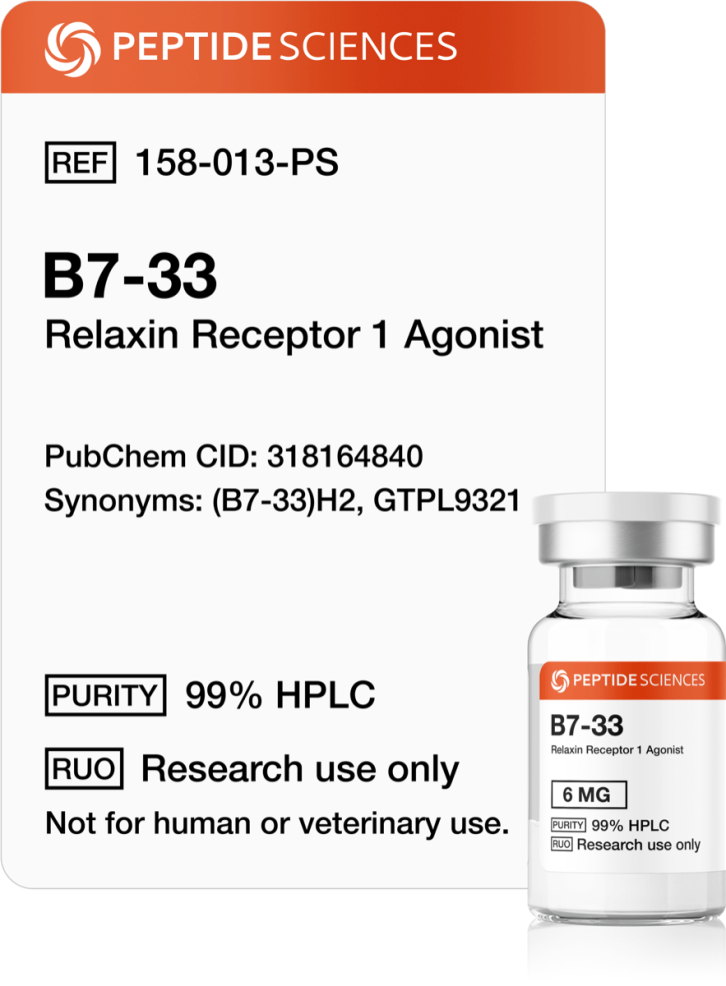
B7-33 (Relaxin Analog) 6mg
$70.00
PRODUCT SHORT DESCRIPTION
B7-33 6mg is a premium, high-purity synthetic single-chain peptide analogue of human gene-2 relaxin (H2 relaxin). This 6,000mcg configuration provides an exceptionally precise biochemical tool for investigating RXFP1 signaling pathways, matrix metalloproteinase (MMP) activation, and tissue-specific anti-fibrotic kinetics without triggering tumor-promoting cascades.
Introduction to B7-33 6mg (Relaxin Analogue)
B7-33, biochemically classified as a functional single-chain peptide analogue of the endogenous mammalian hormone human gene-2 relaxin (H2 relaxin), is a targeted molecular probe engineered for high-resolution research into cardiovascular remodeling, chronic fibrosis, pulmonology, and gestational vascular mechanics. Unlike native H2 relaxin, which features a complex, dual-chain disulfide-linked structure ($\text{A-chain}$ and $\text{B-chain}$) that presents notable synthesis and stability challenges, B7-33 is derived exclusively from a truncated, linear segment of the native receptor-binding domain.
In native biological systems, endogenous relaxin is a crucial pleiotropic hormone that modulates extracellular matrix turnover and vascular compliance. However, its long-term deployment in laboratory models can activate multi-pathway cross-talk, including the unwanted upregulation of cyclic adenosine monophosphate (cAMP) loops linked to certain oncogenic or hyperproliferative side-channel artifacts. B7-33 bypasses these experimental variables by functioning as a functionally selective, biased agonist. At USA PEPTIDE SCIENCES, we supply this advanced structural matrix as a premium 6mg lyophilized vial, providing molecular biology, pathology, and cardiology research institutions with an ultra-pure, standardized baseline reagent to map tissue-specific recovery curves and collagen remodeling kinetics.
Research Overview: Selective RXFP1 Activation and Anti-Fibrotic Kinetics
The primary scientific value of B7-33 6mg centers on its specific affinity for the Relaxin Family Peptide Receptor 1 (RXFP1). By operating as a biased agonist, it binds to RXFP1 and preferentially stimulates the extracellular signal-regulated kinase 1/2 ($\text{ERK1/2}$) and matrix metalloproteinase-9 ($\text{MMP-9}$) signaling axes while triggering minimal to no traditional $\text{G}_s$-protein-mediated cAMP accumulation. This selective signaling allows researchers to isolate pure anti-fibrotic mechanics under controlled laboratory conditions.
Key areas of active scientific investigation utilizing B7-33 6mg include:
-
Myocardial Remodeling and Post-Injury Scar Reduction: Modeling the structural maintenance of cardiac architecture following ischemic trauma or acute heart failure. In animal models of myocardial infarction, B7-33 is highly scrutinized for its capacity to reduce excessive scar tissue accumulation by roughly 50%. Researchers track the downregulation of collagen Type I and Type III synthesis within cardiac fibroblasts, observing its downstream impact on preserving left ventricular ejection fraction and extending animal longevity curves.
-
Pulmonary Fibrosis and Lung Inflammation Suppression: Investigating the modulation of extracellular matrix deposition in chronic respiratory stress frameworks. Investigators utilize B7-33 to evaluate the suppression of transforming growth factor-beta 1 ($\text{TGF-}\beta\text{1}$) induced fibrotic cascades in alveolar tissues. Studies track the inhibition of myofibroblast differentiation, assessing how the peptide mitigates structural stiffness in compromised lung tissue models.
-
Renal Homeostasis and Chronic Kidney Disease Kinetics: Tracking the preservation of functional parenchymal architecture. Researchers analyze B7-33’s capability to clear obstructive connective tissue barriers within the glomerulus and tubulointerstitial spaces, mapping the restoration of localized vascular compliance and filtration efficiency.
-
Vascular Endothelial Stabilization and Preeclampsia Simulations: Evaluating secondary gestational and vascular regulation loops. In experimental models of preeclampsia, B7-33 is studied for its ability to correct endothelial dysfunction, stimulate nitric oxide ($\text{NO}$) generation, and lower systemic vascular resistance without altering baseline heart rate parameters.
Biased Agonism and Molecular Precision
To maintain strict analytical resolution, the structural conformation of B7-33 is engineered to decouple the beneficial tissue-remodeling properties of relaxin from its wider systemic endocrinological artifacts. This precise biochemical segregation guarantees that:
-
Biased RXFP1 Signaling Verification: Cells exposed to B7-33 demonstrate direct upregulations in matrix-degrading enzymes ($\text{MMP-2}$ and $\text{MMP-9}$), allowing for clear quantification of collagen clearance curves.
-
Proliferative Variable Elimination: By avoiding standard $\text{G}_s$-driven cAMP hyper-activation, researchers can evaluate long-term anti-fibrotic dynamics without inducing unwanted proliferative or tumor-promoting artifact profiles in local cell lines.
Quality Standards & Analytical Testing
At USA PEPTIDE SCIENCES, laboratory data integrity and compound reproducibility are the fundamental core of our manufacturing operations. Every single production lot of B7-33 6mg undergoes a strict quality control validation protocol to eliminate compounding variables and experimental artifacts. We utilize High-Performance Liquid Chromatography (HPLC) coupled with Mass Spectrometry (MS) to confirm an absolute chemical purity profile of 99% or greater. This rigorous analytical validation verifies the exact single-chain sequence composition, precise molecular weight, and correct linear spatial conformation while ensuring the total absence of residual synthesis reagents, truncated fragments, heavy metals, or raw contaminants. A batch-specific Certificate of Analysis (COA) accompanies every order to guarantee absolute reproducibility.
Storage and Handling Requirements
To safeguard the complex molecular bonds and prevent structural degradation of the 6mg lyophilized cake, all vials must be stored long-term in a freezer environment at -20°C, completely shielded from light and ambient moisture. Prior to introducing the compound into your laboratory workflow, reconstitution must be carried out using an appropriate sterile, non-pyrogenic, or bacteriostatic diluent. Once transitioned into a liquid state, the peptide solution becomes highly sensitive to thermal breakdown and mechanical shear stress; reconstituted vials must be maintained under constant refrigeration at 2°C to 8°C. Researchers must dissolve the compound via a slow, gentle swirling motion, avoiding any aggressive mechanical agitation, inversion, or shaking, which can permanently disrupt the synthetic matrix.
Research Use Disclaimer
The compounds distributed by USA PEPTIDE SCIENCES, including B7-33 6mg research vials, are designated strictly for laboratory research purposes only. Under no circumstances are these products approved or intended for human or veterinary consumption, direct clinical diagnostics, or therapeutic drug administration. All handling, measuring, and experimental evaluation must be conducted exclusively by qualified scientific professionals within a certified and monitored research facility.
Maud –
Brad –
Cristobal –
I’ve been following the relaxin analog literature and this peptide works as described in the research. B7-33 binds to RXFP1 and preferentially activates the pERK pathway over cAMP signaling, which is proposed to reduce the tumor-promoting risk associated with native relaxin. In preclinical models, B7-33 prevented or reversed organ fibrosis in heart and lung disease models with similar potency to H2 relaxin. The 6mg size is practical for research cycles and the peptide has performed consistently in my protocols.
Rosa –
Ordering went smoothly but support took a couple of days to respond to technical questions. I observed moderate anti-fibrotic effects, but the research data shows B7-33 has a very short half-life in serum—approximately 6 minutes—which requires frequent dosing in animal models or continuous infusion protocols. The 6mg vial size requires careful planning to get through a full study without reordering mid-cycle.
Bernadine –
The quality is solid, but the 6mg vial is relatively small for extended in vivo protocols requiring daily or twice-daily injections. I’ve read that lipidated versions of B7-33 have been developed to extend half-life from 6 minutes to 60 minutes, which would be more practical for certain research models. Solid research peptide, but the stability limitations and limited supply for extended studies were drawbacks.
Angelica –
This was my first time using B7-33 for scarring research, and the results exceeded my expectations. It consistently reduced TGF-β1-induced profibrotic signaling in hypertrophic scar fibroblasts, with significantly greater COL1A1 downregulation compared to reference antifibrotic agents in one study . The peptide is a clear standout for anti-scarring research.
Jamie –
Disappointed with this one. The peptide arrived, but its half-life is extremely short—about 6 minutes in serum . This requires near-continuous dosing for our models, which was impractical with the 6mg vial. I reached out to support for advice on stabilizing the molecule, but I didn’t get a clear answer. Unless your research can handle daily injections and rapid clearance, this peptide is a logistical challenge. I might try a lipidated, longer-lasting version next time.
Ismael –
Disappointed with this one. The peptide arrived, but its 6-minute half-life in human serum meant it required near-continuous dosing or mini-pump infusion for my protocols, which was impractical with the 6mg vial. I reached out to support for advice on stabilization, but I didn’t get a clear answer. While B7-33 is an important research tool for RXFP1 pharmacology and fibrosis studies, its stability limitations are a significant hurdle. I might try a lipidated, longer-lasting version next time.
Zetta –
Support was proactive with handling guidance—the peptide is hygroscopic, should be stored at -20°C desiccated, and reconstituted solutions should be aliquoted to avoid freeze-thaw cycles. Shipping was quick and packaging secure. The B7-33 has performed well, with the expected effects on collagen turnover and tissue remodeling in my models. Excellent value for research applications.
Kayli –
I’ve been following the literature on relaxin analogs for a while, and this B7-33 works as described. It selectively activates RXFP1 and shows antifibrotic effects on fibroblast cell lines . The shipping was fast, and the 6mg size allowed for a full cycle. This peptide is a valuable tool for research.
Cordia –
I’m uncertain this B7-33 formulation lived up to expectations for my research. The ordering process was fine, and the product arrived quickly, but support gave a generic response when I asked for comparative data against other antifibrotic peptides. While the 2024 study published in the Journal of Hypertension confirms B7-33 normalizes blood pressure and reduces inflammatory markers like TNF-alpha in rodent models of preeclampsia , translating those outcomes to my specific research model proved difficult. For the cost, I expected more consistent results.