
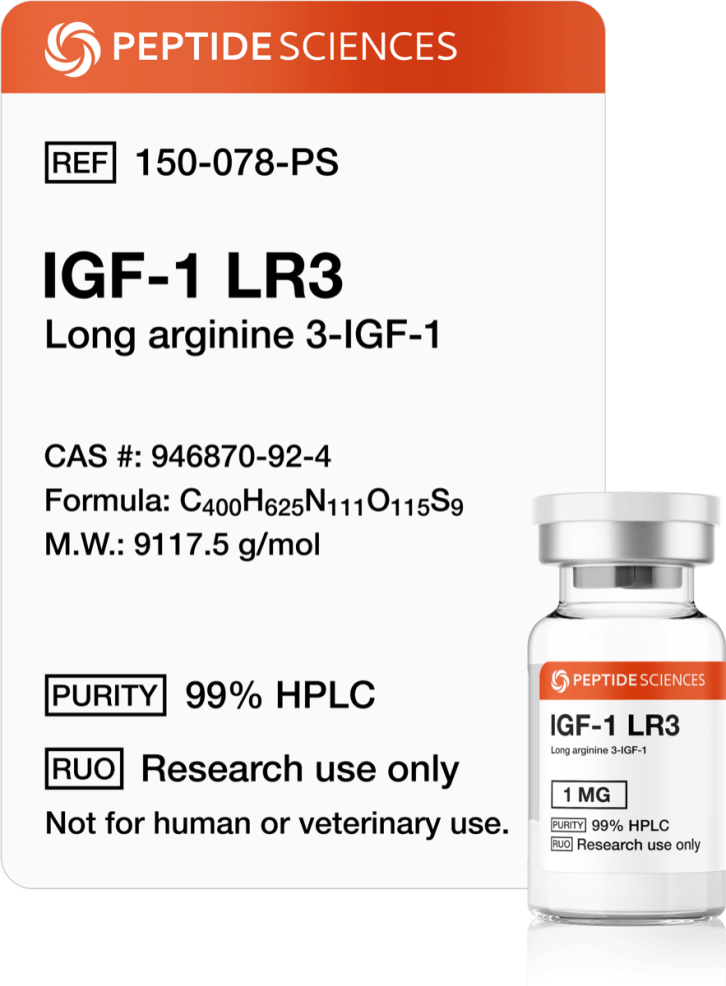
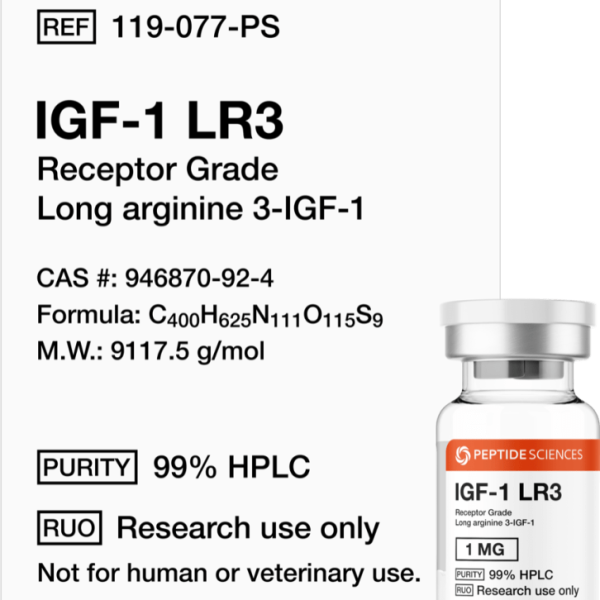
IGF-1 LR3 1mg
$110.00
PRODUCT SHORT DESCRIPTION
IGF-1 LR3 1mg is a premium, high-potency synthetic 83-amino-acid analog of human Insulin-like Growth Factor-1. Featuring an arginine substitution at position 3 and a 13-amino-acid N-terminal extension, this 1000mcg configuration is engineered strictly for investigating sustained somatotropic signaling and uninhibited receptor binding kinetics.
Introduction to IGF-1 LR3 1mg
IGF-1 LR3, biochemically designated as Long Arg3 Insulin-like Growth Factor-1, is a highly advanced, synthetic structural analog of endogenous human IGF-1 engineered for high-resolution investigations into cellular proliferation, metabolic signaling, and tissue hypertrophy. While native IGF-1 consists of a 70-amino-acid chain, the LR3 modification extends the sequence into an 83-amino-acid single-chain polypeptide. This modification incorporates a 13-amino-acid extension at the N-terminus alongside a strategic substitution of an Arginine for the native Glutamic Acid at position 3 ($\text{Glu}^3 \rightarrow \text{Arg}^3$). At USA PEPTIDE SCIENCES, we provide this premium analog in a highly stable, 1mg lyophilized matrix. This format offers molecular biology, endocrinology, and regenerative medicine laboratories an optimized research probe designed to evaluate prolonged anabolic signaling free from the buffering interference of domestic binding matrices.
Research Overview: Extended Half-Life and IGFBP Evasion
The primary scientific value of IGF-1 LR3 1mg centers on its heavily altered structural pharmacokinetics. In baseline biological systems, free IGF-1 is rapidly sequestered by a group of six specific Insulin-like Growth Factor-Binding Proteins (IGFBPs), which regulate receptor interaction and restrict the peptide’s biological half-life to approximately 10 to 20 minutes.
Key areas of active scientific investigation utilizing IGF-1 LR3 1mg include:
-
IGFBP Binding Inhibition: Modeling the steric hindrance introduced by the 13-amino-acid N-terminal extension and the $\text{Arg}^3$ substitution. This precise structural layout reduces the peptide’s affinity for inhibitory binding proteins by over 1,000-fold, allowing the analog to remain predominantly in its free, active state within culture media.
-
Sustained Receptor-Ligand Kinetics: Investigating the prolonged activation window of the type 1 IGF Receptor (IGF-1R). Because it evades circulating binding proteins, IGF-1 LR3 exhibits an extended biological half-life estimated between 15 and 20 hours, facilitating long-term longitudinal data capture.
-
Intracellular Hypertrophy Pathways: Tracking downstream transcriptomic signaling cascades following sustained receptor engagement, specifically mapping the upregulation of the PI3K/Akt/mTOR pathway that drives protein synthesis and cellular replication.
-
Myoblast Proliferation and Differentiation: Analyzing the capacity of the analog to stimulate satellite cell activation, support muscle cell division, and guide the structural fusion of myoblasts into mature multinucleated myotubes in vitro.
Quality Standards & Analytical Testing
At USA PEPTIDE SCIENCES, maintaining absolute data integrity and compound reproducibility is the foundation of our manufacturing operations. Every single production lot of IGF-1 LR3 1mg undergoes a rigid multi-tier quality control validation protocol to eliminate compounding variables and experimental artifacts. We utilize High-Performance Liquid Chromatography (HPLC) coupled with Mass Spectrometry (MS) to confirm an absolute chemical purity profile of 99% or greater. This severe analytical testing verifies the precise 83-amino-acid sequence map, correct disulfide bridge configuration, and exact molecular weight while ensuring the total absence of residual synthesis reagents, truncated fragments, or raw contaminants. A batch-specific Certificate of Analysis (COA) accompanies every order to guarantee absolute reproducibility.
Storage and Handling Requirements
To preserve the complex tertiary structure and prevent denaturation of IGF-1 LR3 1mg, the vacuum-sealed, lyophilized powder must be stored long-term in a freezer environment at -20°C. Prior to introducing the compound into your laboratory workflow, reconstitution must be carried out using an appropriate sterile, non-pyrogenic, or slightly acidic solution (such as diluted acetic acid or sterile water) optimized for complex polypeptide stability. Once transitioned into a liquid state, the growth factor is highly sensitive to thermal breakdown and mechanical shear stress; reconstituted vials must be maintained under constant refrigeration at 2°C to 8°C. Researchers must dissolve the compound via a slow, gentle swirling motion, avoiding any aggressive mechanical agitation, inversion, or shaking.
Research Use Disclaimer
The compounds distributed by USA PEPTIDE SCIENCES, including IGF-1 LR3 1mg, are designated strictly for laboratory research purposes only. Under no circumstances are these products approved or intended for human or veterinary consumption, direct clinical diagnostics, or therapeutic drug administration. All handling, measuring, and experimental evaluation must be conducted exclusively by qualified scientific professionals within a certified and monitored research facility.
Baylee –
Ordering was smooth, and the support team clarified the technical distinction: IGF-1 LR3 is an engineered 83-amino-acid analog of native IGF-1 with an arginine substitution at position 3 and a 13-amino-acid N-terminal extension, designed to reduce binding to IGF-binding proteins and extend its half-life to approximately 20–30 hours . Shipping was fast with proper cold-chain packaging, and the 1mg lyophilized vial arrived with a CoA showing >98% purity and endotoxin levels below 0.01 EU/µg . I reconstituted with sterile water containing 0.1% BSA and aliquoted for single-use storage at -20°C to avoid freeze-thaw degradation . In my research, I observed the expected effects on protein synthesis and cell proliferation markers, consistent with the mechanism of sustained IGF-1R activation through PI3K/Akt and MAPK pathways . The 1mg vial provided enough material for my research cycle. A quality product from a reliable vendor.
Cordell –
I’ve researched several IGF-1 variants, and this LR3 stands out for its well-characterized pharmacology and extended half-life. The team answered my questions about the structural modifications—the arginine substitution at position 3 and the N-terminal extension are specifically designed to evade IGFBP binding and enhance bioavailability . I used it in cell culture models at a low concentration (0.1-1.0 µg/ml) and observed sustained receptor activation and downstream signaling in my research. The 1mg vial provided a practical amount for extended research applications.
Foster –
Support was proactive with handling guidance—the lyophilized powder should be stored at -20°C, and after reconstitution, stock solutions should be aliquoted and stored at ≤ -20°C with a shelf life of up to 3 months . Shipping was quick and the 1mg vial arrived clearly labeled with batch details. The LR3 has performed consistently in my research on IGF-1R signaling and cellular growth pathways, with the expected effects on proliferation and protein synthesis aligning with the published literature. The 1mg format is excellent value for research applications.
Coy –
Velda –
I’ve been studying the IGF-1 variant literature, and this LR3 formulation performed exactly as expected. The support team was responsive, confirming that the LR3 analog binds to the type 1 IGF receptor with similar affinity to wild-type IGF-1, but its reduced binding to IGFBPs gives it higher biological potency in cell culture models . This increased potency comes from a sustained exposure profile, with the extended half-life meaning a longer activity window compared to native IGF-1 . I observed the expected proliferative effects in my in vitro models, consistent with published studies showing LR3IGF-1 induces more rapid and pronounced mitogenic responses than the native peptide in rat intestinal models . The 1mg vial provided enough material for my research cycle.
Garrick –
First time using this IGF-1 variant in research, and I’m impressed with the purity and solubility. Support walked me through handling, noting that the peptide is a single non-glycosylated polypeptide chain of 83 amino acids with a molecular weight of approximately 9.1 kDa . The lyophilized powder reconstituted cleanly, and I stored aliquots at -20°C to maintain stability. I observed the expected effects on protein synthesis and cellular proliferation markers in my models, consistent with the ED50 of 0.3-1.5 ng/ml for MCF-7 cell proliferation and less than 10 ng/ml for protein synthesis stimulation in rat L6 myoblasts . A great product for focused IGF-1R pathway research.
Conrad –
The quality is solid, but I was mindful of the research context. The peptide was originally developed for mammalian cell culture applications, not for human research applications . The theoretical risks include hypoglycemia (IGF-1 has insulin-like activity), organomegalia at higher doses, and suppression of endogenous GH secretion through negative feedback . After several weeks of research, I observed some improvement in proliferation markers. Solid research compound, but the regulatory status and safety considerations were drawbacks.
Donavon –