
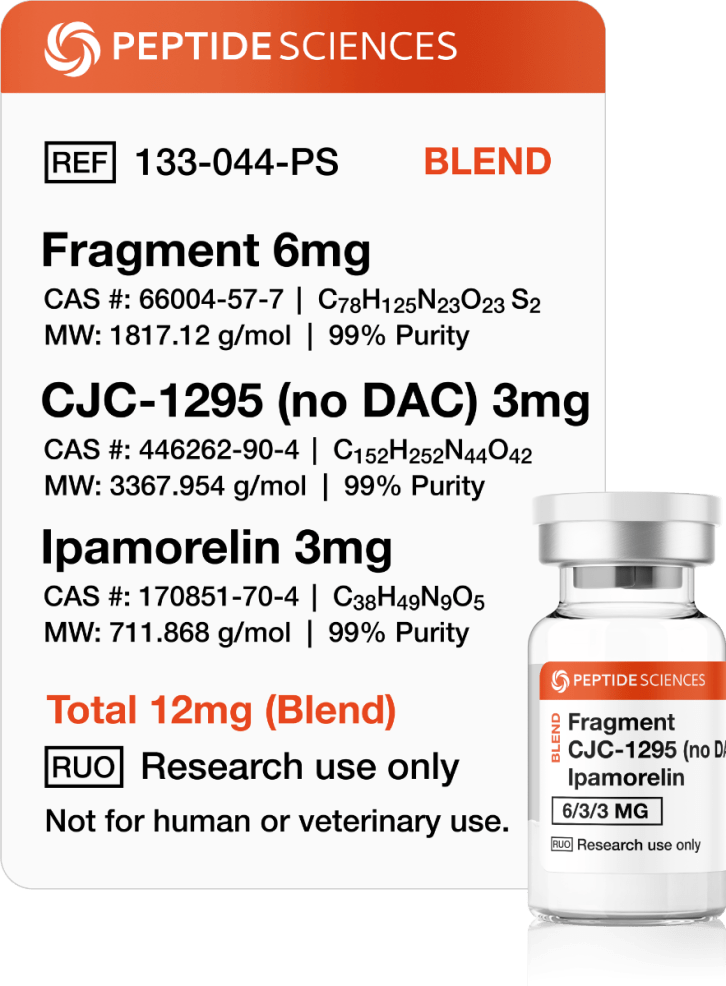
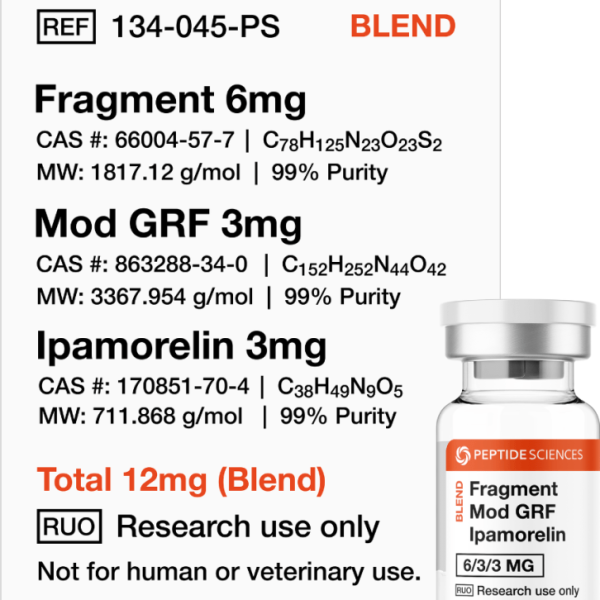
Fragment 176-191 Peptide, CJC-1295 (No DAC), Ipamorelin 12mg (Blend)
$100.00
PRODUCT SHORT DESCRIPTION
The Fragment, CJC-1295 No DAC, and Ipamorelin formulation delivers an advanced, triple-action 12mg (12000mcg) research blend combining three synergistic synthetic peptides in a single vial. This ratio is engineered strictly for investigating dual-receptor somatotroph coordination, optimized growth hormone (GH) pulsatility, and parallel lipid metabolism pathways.
Fragment 176-191 Peptide + CJC-1295 No DAC + Ipamorelin 12mg Blend
Introduction to the Triple-Action Somatotropic Matrix
The Fragment, CJC-1295 No DAC, Ipamorelin 12mg Blend represents a sophisticated multi-pathway research platform designed to evaluate compound interactions along the mammalian growth-hormone axis and peripheral metabolic systems.
Rather than focusing on a single signaling mechanism, this advanced 12,000mcg research blend combines three distinct synthetic peptide architectures: a fragment 176-191 peptide associated with C-terminal growth-hormone metabolic research, a growth hormone-releasing hormone (GHRH)-related peptide identified in this formulation as CJC-1295 No DAC, and the selective growth hormone secretagogue Ipamorelin.
At USA PEPTIDE SCIENCES, we supply this parallel-action matrix in a precisely prepared, vacuum-sealed lyophilized format, providing endocrinology, metabolic biochemistry, and molecular-biology laboratories with a standardized material for investigating receptor cross-talk, pituitary signaling, and adipose-associated pathways.
For laboratories researching fragment 176-191 peptide mechanisms alongside GHRH- and GHS-associated pathways, the combined 12mg format enables several distinct signaling systems to be examined within a single controlled research matrix.
Fragment 176-191 Peptide Research Overview
The primary scientific value of the blend centers on multi-pathway endocrine and metabolic investigation.
Native endocrine responses involve intersecting signaling networks rather than isolated receptor pathways. Combining a fragment 176-191 peptide with CJC-1295 No DAC and Ipamorelin provides researchers with a framework for examining how metabolic and secretagogue-associated pathways behave concurrently.
Multi-Pathway Secretagogue and Metabolic Research
Key areas of scientific investigation include:
- Dual-Receptor Pituitary Signaling: Modeling signaling that occurs when a GHRH-related peptide interacts with GHRH receptors while Ipamorelin engages growth-hormone-secretagogue-associated receptor pathways. Researchers can evaluate downstream cAMP- and phospholipase-associated signaling within controlled pituitary models.
- Fragment 176-191 Peptide Metabolic Research: Investigating the C-terminal growth-hormone region in experimental adipose-tissue and lipid-metabolism models without automatically attributing the full biological profile of intact growth hormone to the fragment.
- Beta-Adrenergic Pathway Research: C-terminal GH-fragment research has explored relationships with beta-adrenergic signaling and β3-adrenergic-receptor expression. Published work with the related C-terminal analogue AOD9604 indicates that β3-AR pathways may contribute to metabolic responses, while also showing that the observed effects are not simply the result of direct β3-receptor mediation.
- Selective Ipamorelin Signaling: Investigating a synthetic pentapeptide secretagogue that has demonstrated strong GH-release selectivity in preclinical research, with substantially less ACTH and cortisol activation than some earlier GHRPs in the experimental systems studied.
- Receptor Cross-Talk: Comparing the simultaneous presence of GHRH-associated and GHS-associated signaling with experiments using either pathway independently.
- Somatostatin-Associated Feedback: Examining how secretagogue signaling interacts with endogenous inhibitory feedback systems within experimental pituitary and hypothalamic models.
Researchers studying fragment 176-191 peptide, C-terminal GH fragments, CJC-1295 No DAC, Ipamorelin, GHRH signaling, and growth-hormone secretagogues can review fragment 176-191 peptide and growth-hormone research on PubMed for relevant peer-reviewed literature.
Fragment 176-191 Peptide and Lipid Metabolism Research
The fragment 176-191 peptide component represents a C-terminal region associated with human growth-hormone fragment research.
Early investigations of synthetic C-terminal GH sequences explored their effects on lipid metabolism and adipose-tissue signaling. Related research with C-terminal analogue AOD9604 has also examined fat oxidation, lipolytic sensitivity, energy expenditure, and beta-adrenergic pathways.
This area of fragment 176-191 peptide research may include:
- Adipocyte signaling
- Lipid-metabolism pathways
- Lipolysis-associated mechanisms
- Lipogenesis-associated pathways
- Beta-adrenergic signaling
- Metabolic gene expression
- Energy-utilization models
- Comparison with full-length human growth hormone
These findings are preclinical research observations and should not be interpreted as evidence of human weight-loss or therapeutic effects.
CJC-1295 No DAC Research Component
The CJC-1295 No DAC component is supplied within this blend as a GHRH-related research peptide intended for laboratory investigation of GHRH-receptor signaling.
Modified GRF-type peptides are engineered from the biologically active N-terminal region of GHRH and incorporate substitutions designed to improve resistance to rapid enzymatic degradation compared with native GHRH fragments.
Within a fragment 176-191 peptide blend, this component gives laboratories an additional pathway through which to examine:
- GHRH-receptor interactions
- Adenylyl cyclase signaling
- cAMP-associated pathways
- Pituitary somatotroph responses
- Secretagogue cross-talk
- Receptor desensitization
Ipamorelin Research Component
Ipamorelin is a synthetic pentapeptide with the sequence:
Aib-His-D-2-Nal-D-Phe-Lys-NH₂
Published research has characterized Ipamorelin as a selective growth-hormone secretagogue.
In preclinical studies, Ipamorelin stimulated GH release while showing greater selectivity than several earlier-generation secretagogues with respect to ACTH and cortisol signaling.
Its inclusion alongside fragment 176-191 peptide and CJC-1295 No DAC creates a research matrix spanning both secretagogue-associated and metabolic pathways.
Fragment 176-191 Peptide Blend Research Profile
- Product: Fragment + CJC-1295 No DAC + Ipamorelin Blend
- Total research quantity: 12mg / 12,000mcg
- Fragment component: C-terminal human growth-hormone fragment research peptide
- CJC-1295 No DAC component: GHRH-related research peptide
- Ipamorelin component: Synthetic pentapeptide growth-hormone secretagogue
- Ipamorelin sequence: Aib-His-D-2-Nal-D-Phe-Lys-NH₂
- Primary research areas: Metabolic signaling, GHRH pathways, secretagogue signaling, receptor cross-talk, and pituitary models
- Format: Lyophilized research peptide blend
- Purity: ≥99% according to supplied specifications
- Analytical testing: HPLC and Mass Spectrometry
- Intended use: Laboratory and in-vitro research only
Individual component quantities are not stated here because only the 12mg total blend quantity was provided.
Peptide Sciences CJC 1295 and Fragment Research
The phrase peptide sciences cjc 1295 is commonly used in searches for CJC-1295-related research materials and laboratory peptide suppliers.
On this page, the product is supplied specifically by USA Peptide Sciences and combines CJC-1295 No DAC with Ipamorelin and a fragment 176-191 peptide in a 12mg research formulation.
No affiliation with any separate company operating under a similar “Peptide Sciences” name is implied.
Researchers can explore the USA Peptide Sciences laboratory peptide catalogue for additional GHRH, GHS, metabolic, and comparative research materials.
Fragment 176-191 Peptide Quality Standards & Analytical Testing
At USA PEPTIDE SCIENCES, laboratory data integrity and compound reproducibility are fundamental to our manufacturing operations.
Every production lot of the Fragment, CJC-1295 No DAC, Ipamorelin 12mg Blend undergoes analytical validation designed to minimize experimental variability.
We utilize High-Performance Liquid Chromatography (HPLC) coupled with Mass Spectrometry (MS) to confirm a combined purity profile of 99% or greater according to the supplied product specifications.
Analytical testing supports assessment of peptide identity, molecular characteristics, and overall composition while helping identify unwanted synthesis-related impurities or truncated material.
A batch-specific Certificate of Analysis (COA) accompanies each order according to the supplied specifications.
For researchers evaluating fragment 176-191 peptide experiments involving multiple active components, consistent analytical characterization is especially important when comparing results across experimental runs.
Fragment 176-191 Peptide Blend Storage and Handling
To safeguard the molecular integrity of the 12mg lyophilized research matrix, the supplied vial should be stored long-term at -20°C according to the product specifications.
Prior to laboratory assays, reconstitution should be conducted using an appropriate sterile, non-pyrogenic, or bacteriostatic research diluent.
Once transitioned into solution, the peptide blend should be maintained under refrigeration between 2°C and 8°C.
Researchers should dissolve the material using a slow, gentle swirling motion while avoiding aggressive mechanical agitation, inversion, or shaking.
Qualified laboratories can visit the USA Peptide Sciences research peptide website or browse the USA Peptide Sciences research compound shop for additional research materials.
Fragment 176-191 Peptide FAQ
What is fragment 176-191 peptide?
Fragment 176-191 peptide refers to a synthetic peptide representing the C-terminal region associated with human growth-hormone fragment research.
It is primarily investigated in experimental lipid-metabolism, adipose-tissue, and metabolic-signaling models.
What is the Fragment, CJC-1295 No DAC and Ipamorelin 12mg Blend?
It is a combined laboratory research formulation containing a fragment 176-191 peptide, CJC-1295 No DAC, and Ipamorelin.
The three components provide distinct metabolic, GHRH-associated, and growth-hormone-secretagogue research pathways within one lyophilized matrix.
What is fragment 176-191 peptide studied for?
Fragment 176-191 peptide has been investigated in research involving C-terminal growth-hormone biology, lipid metabolism, adipose-tissue signaling, lipolysis-associated mechanisms, lipogenesis, and beta-adrenergic pathways.
These are experimental research areas rather than established human benefits.
Does fragment 176-191 peptide directly activate beta-3 adrenergic receptors?
The evidence is more nuanced.
Research involving the related C-terminal GH analogue AOD9604 found changes in β3-adrenergic-receptor expressionand lipolytic sensitivity. However, the study concluded that its metabolic actions were not mediated directly through β3-AR alone.
For this reason, the mechanism should be described as an interaction with beta-adrenergic pathways rather than a proven direct β3-receptor agonist effect.
Is Fragment 176-191 the same as AOD9604?
They are closely related C-terminal growth-hormone research concepts, but the names should not automatically be treated as chemically interchangeable.
Researchers should distinguish the exact peptide identity specified by the analytical documentation for the material being studied.
What is CJC-1295 No DAC studied for?
CJC-1295 No DAC is used in laboratory research involving GHRH-associated receptor signaling, pituitary somatotroph activity, cAMP pathways, and secretagogue interactions.
What does peptide sciences cjc 1295 mean?
Peptide sciences cjc 1295 is a search phrase commonly associated with CJC-1295 laboratory research and peptide suppliers.
The product on this page is supplied specifically by USA Peptide Sciences, and no affiliation with a separate similarly named supplier is implied.
Is CJC-1295 pill form available in this blend?
No. The phrase cjc-1295 pill form appears in search queries, but this USA Peptide Sciences product is supplied as a lyophilized 12mg laboratory research blend, not as pills or oral capsules.
No oral administration claim is made.
What is Ipamorelin?
Ipamorelin is a synthetic pentapeptide growth-hormone secretagogue studied for selective pituitary GH-release signaling.
Its sequence is Aib-His-D-2-Nal-D-Phe-Lys-NH₂.
Why is Ipamorelin considered selective in research?
Published preclinical research found that Ipamorelin stimulated GH release while producing substantially less ACTH and cortisol activation than GHRP-2 and GHRP-6 under the experimental conditions studied.
That observation relates to controlled experimental models and should not be interpreted as a clinical safety claim.
Why combine fragment 176-191 peptide with CJC-1295 No DAC and Ipamorelin?
Combining the components creates a single research matrix for examining several distinct signaling systems simultaneously.
The fragment 176-191 peptide provides a C-terminal GH-fragment metabolic research component, CJC-1295 No DAC provides a GHRH-associated pathway, and Ipamorelin provides a GHS-associated secretagogue pathway.
Does this blend prove synergistic growth-hormone release?
No blend-specific evidence was supplied establishing a quantitatively proven synergistic or supra-additive response for this exact three-component formulation.
Researchers can investigate potential pathway interactions, but the combined product should not be described as conclusively producing a response greater than the mathematical sum of its individual components without supporting experimental data.
How much material is supplied in the blend?
The supplied product information specifies 12mg total research material, equivalent to 12,000mcg.
Individual quantities of the three components were not provided and therefore are not stated.
What purity is the fragment 176-191 peptide blend?
According to the supplied specifications, the combined material has a purity profile of 99% or greater, with HPLC and Mass Spectrometry used for analytical validation.
Does the blend include a Certificate of Analysis?
Yes. According to the supplied product information, a batch-specific Certificate of Analysis accompanies each research order.
How should the fragment 176-191 peptide blend be stored?
According to the supplied specifications, the fragment 176-191 peptide blend should be stored at -20°C while lyophilized.
Following controlled laboratory reconstitution, the research material should be maintained between 2°C and 8°C.
Can researchers find fragment 176-191 peptide studies on PubMed?
Yes. Researchers can review fragment 176-191 peptide, C-terminal GH fragment, CJC-1295, and Ipamorelin research on PubMed for scientific literature involving growth-hormone fragments, lipid metabolism, GHRH analogues, secretagogues, and related endocrine pathways.
Where can researchers find related compounds?
Qualified laboratories can explore the USA Peptide Sciences research peptide shop or visit the USA Peptide Sciences laboratory research website for additional metabolic, GHRH, GHS, and comparative peptide research materials.
Is fragment 176-191 peptide intended for human use?
No. Fragment 176-191 peptide supplied as part of this USA Peptide Sciences blend is designated strictly for laboratory and in-vitro research.
The product is not intended for human or veterinary consumption, weight-management use, bodybuilding, performance enhancement, hormone therapy, diagnostic procedures, or therapeutic administration.
Fragment 176-191 Peptide 12mg Research Use Disclaimer
The Fragment, CJC-1295 No DAC, Ipamorelin 12mg Blend distributed by USA PEPTIDE SCIENCES is designated strictly for laboratory research purposes only.
The fragment 176-191 peptide terminology used throughout this page refers exclusively to scientific research involving the peptide and related molecular pathways.
Under no circumstances is this product approved or intended for human or veterinary consumption, clinical diagnostics, therapeutic drug administration, weight-management use, athletic performance enhancement, or any other human application.
All handling, measuring, and experimental evaluation must be conducted exclusively by qualified scientific professionals within an appropriate controlled research facility.
Reyna –
Ordering went smoothly but support took a couple of days to respond to technical questions. I observed moderate effects in my research models, but the results were somewhat variable. It’s worth noting that no published human randomized trial has tested this specific CJC-1295 (no DAC) + Ipamorelin combination at the daily doses common in research planning, though each compound has its own human pharmacokinetic data and the cellular work supports a synergistic mechanism . Good product for research, but the lack of blend-specific clinical data and variable results knocked a star off for me.
Alison –
Arne –
Support was proactive with handling guidance—the lyophilized blend should be stored at -20°C and reconstituted solutions refrigerated at 2-8°C, typically used within 30 days . Shipping was quick and packaging secure. The blend has performed consistently in my research, with the expected effects on GH secretion, sleep quality, and recovery markers aligning with the published mechanism. The 12mg format is excellent value for research applications.
Abraham –
Disappointed with this one. The product arrived but the results were underwhelming. I reached out for more details on the research base but didn’t get a clear explanation. I’ve since read that while the blend is commonly presented as a gold standard GH secretagogue combination, the human evidence for the specific pairing at research protocols is limited—each compound has its own human data, but the combination has not been studied in controlled trials . The theoretical and outcome-related risks in a research context, including elevated fasting glucose, joint pain, and the well-established concern that GH and IGF-1 promote cell proliferation, were also considerations for my model . I might try a different approach next time.
Corrine –
Shipping was slightly delayed but the product arrived intact. I observed decent recovery improvements, but the evidence for the combination is primarily mechanistic and case-series based rather than trial-based for the specific use cases in recovery, sleep, and body composition research . The receptor pharmacology is solid and the protocol does what the underlying biology predicts at the level of GH pulse stimulation, but whether the resulting GH response translates into consistent research outcomes depends on the model and protocol . Good product overall, but the evidence gap for the specific blend was a consideration.
Clementine –
I’ve been researching GH secretagogues for a while and this blend is exactly what I needed. The support team was responsive about the no-DAC distinction—the short half-life preserves natural pulsatile GH release rather than producing the sustained elevation seen with DAC-containing versions, making it the typical pairing partner for Ipamorelin . Shipping was prompt with secure packaging and a COA confirming mass spec identity . I’ve observed consistent results in my models, with the expected synergistic effects on GH pulse amplitude—the dual-receptor activation of GHRH and ghrelin pathways produces GH peaks exceeding either agent alone, as established in foundational research . The 12mg vial size is practical for extended research protocols. Top-tier product.