
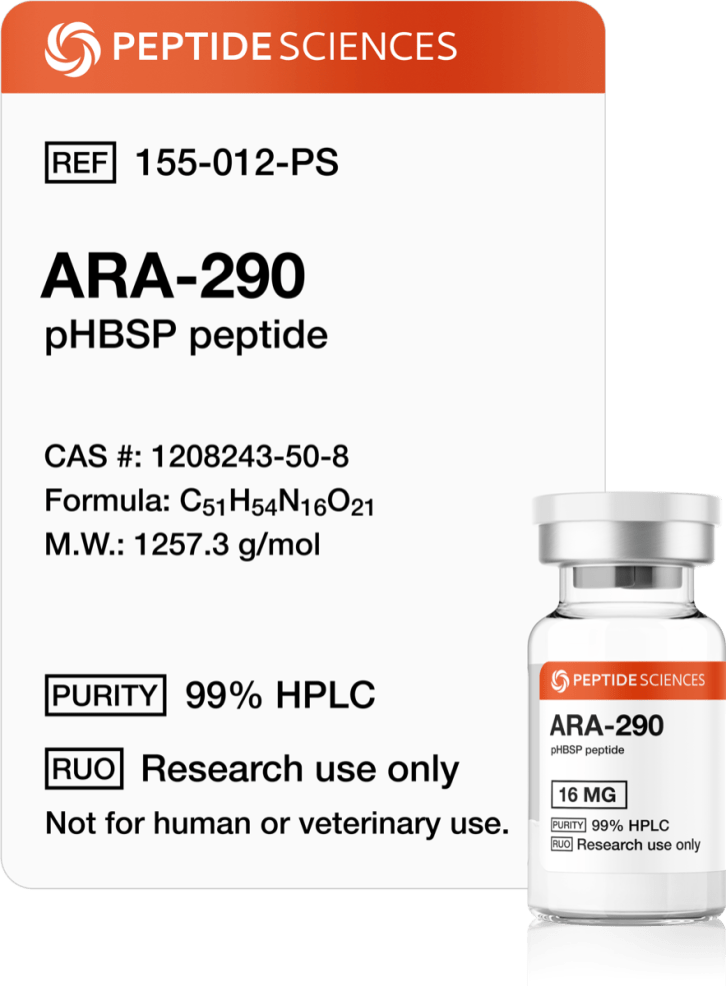
ARA-290 16mg
$95.00
PRODUCT SHORT DESCRIPTION
ARA-290 is a premium, high-purity synthetic 11-amino-acid peptide analogue derived from the non-erythropoietic domain of erythropoietin (EPO). This specialized configuration provides an exceptionally precise biochemical tool for investigating innate repair receptor (IRR) activation, paracrine signaling pathways, and the modulation of chronic neuropathic inflammation without altering hematocrit levels.
Introduction to ARA-290 Peptide (Cibinetide)
ARA-290, biochemically classified as a synthetic 11-amino-acid linear peptide ($\text{L-Glutamyl-L-glutandyl-L-leucyl-L-prolyl-L-aspartyl-L-valinyl-L-tyrosyl-L-isoleucyl-L-isoleucyl-L-glutamyl-L-lysine}$), is a targeted molecular probe engineered for high-resolution research into tissue protection, neurology, and metabolic biochemistry. Derived from the structural loop helix B of the erythropoietin ($\text{EPO}$) molecule, ARA-290 is specifically synthesized to isolate the tissue-protective and anti-inflammatory properties of full-length EPO while completely bypassing its erythropoietic (red blood cell stimulating) pathways.
In native biological systems, standard erythropoietin acts as a crucial survival hormone, but its long-term deployment in non-hematological tissue models introduces a substantial risk of polycythemia, increased blood viscosity, and thrombotic events due to continuous erythroid progenitor cell stimulation. ARA-290 circumvents these experimental variables by interacting exclusively with a unique heteromeric receptor assembly associated with tissue stress. At USA PEPTIDE SCIENCES, we supply this advanced cell-protection matrix as an ultra-pure, standardized baseline reagent, providing biochemistry, neurology, and metabolic disease research institutions with a precise tool to map tissue-specific survival kinetics and repair pathways.
Research Overview: Innate Repair Receptor Agonism and Metabolic Dynamics
The primary scientific value of ARA-290 centers on its specific affinity for the Innate Repair Receptor (IRR), a heterocomplex comprising the erythropoietin receptor ($\text{EPOR}$) and the beta-common receptor ($\text{CD131}$). The IRR is typically unfolded or expressed only during periods of localized tissue trauma, metabolic stress, or hypoxic injury. Once activated by ARA-290, it initiates a cascade of intracellular paracrine signaling networks that suppress pro-inflammatory cytokines and promote cellular survival.
Key areas of active scientific investigation utilizing ARA-290 include:
-
Innate Repair Receptor ($\text{IRR}$) Agonism and Paracrine Signaling: Tracking the immediate shutdown of tissue-destructive pathways. Upon binding to the heteromeric $\text{EPOR/CD131}$ complex, ARA-290 initiates downstream anti-apoptotic signals. This pathway acts as an emergency brake on the innate immune system’s inflammatory cascade, allowing researchers to study cellular preservation independently from basic systemic immune suppression.
-
Neuropathic Pain Modulation and Nerve Fiber Protection: Investigating the stabilization of peripheral nervous system architecture. In animal models of small fiber neuropathy and metabolic nerve damage, ARA-290 is scrutinized for its capacity to reduce localized neuroinflammation. Investigators track the preservation and regeneration of intraepidermal nerve fibers ($\text{IENFD}$), alongside the downregulation of tactile allodynia and thermal hyperalgesia markers.
-
Glycemic Regulation and HbA1c Reduction Kinetics: Evaluating secondary metabolic stabilization curves. Research models focusing on metabolic dysfunction and glucose handling utilize ARA-290 to monitor changes in insulin sensitivity and pancreatic beta-cell viability. Studies evaluate how the reduction of chronic, low-grade tissue inflammation correlates with lower hemoglobin A1c ($\text{HbA1c}$) baselines and improved overall glucose clearance curves.
-
Lipid Profile Optimization and Vascular Homeostasis: Analyzing the peptide’s impact on cardiovascular and lipid biomarkers. Researchers utilize ARA-290 to track fluctuations in serum cholesterol, mapping its potential to reduce low-density lipoprotein ($\text{LDL}$) oxidation and minimize macrophage foam cell formation within endothelial matrices.
-
Accelerated Wound Repair and Cutaneous Morphogenesis: Modeling the activation of localized structural tissue remodeling. By optimizing the tissue microenvironment and encouraging cell survival, ARA-290 is heavily studied for its ability to accelerate dermal closure, downregulate matrix metalloproteinases, and stimulate balanced extracellular matrix deposition in compromised tissue fields.
Non-Erythropoietic Engineering and Safety Isolation
To maintain strict analytical resolution, the primary amino acid sequence of ARA-290 is meticulously organized to lack any structural affinity for the homodimeric erythropoietin receptor configuration ($\text{(EPOR)}_2$) found on erythroid progenitor cells. This intentional biochemical bifurcation guarantees that:
-
Hematocrit Baseline Stability: No change in hemoglobin, hematocrit, or total red blood cell mass occurs, even during prolonged animal exposure models.
-
Thrombotic Variable Elimination: Researchers can evaluate high-dose anti-inflammatory and tissue-protective curves without introducing blood-viscosity artifacts or clotting variables.
Quality Standards & Analytical Testing
At USA PEPTIDE SCIENCES, laboratory data integrity and compound reproducibility are the fundamental core of our manufacturing operations. Every single production lot of ARA-290 undergoes a strict quality control validation protocol to eliminate compounding variables and experimental artifacts. We utilize High-Performance Liquid Chromatography (HPLC) coupled with Mass Spectrometry (MS) to confirm an absolute chemical purity profile of 99% or greater. This rigorous analytical validation verifies the exact 11-amino-acid sequence composition, precise molecular weight, and correct linear spatial conformation while ensuring the total absence of residual synthesis reagents, truncated fragments, heavy metals, or raw contaminants. A batch-specific Certificate of Analysis (COA) accompanies every order to guarantee absolute reproducibility.
Storage and Handling Requirements
To safeguard the complex molecular bonds and prevent structural degradation of the lyophilized cake, all vials must be stored long-term in a freezer environment at -20°C, completely shielded from light and ambient humidity. Prior to introducing the compound into your laboratory workflow, reconstitution must be carried out using an appropriate sterile, non-pyrogenic, or bacteriostatic diluent. Once transitioned into a liquid state, the peptide solution becomes highly sensitive to thermal breakdown and mechanical shear stress; reconstituted vials must be maintained under constant refrigeration at 2°C to 8°C. Researchers must dissolve the compound via a slow, gentle swirling motion, avoiding any aggressive mechanical agitation, inversion, or shaking, which can permanently disrupt the delicate synthetic matrix.
Research Use Disclaimer
The compounds distributed by USA PEPTIDE SCIENCES, including ARA-290 research vials, are designated strictly for laboratory research purposes only. Under no circumstances are these products approved or intended for human or veterinary consumption, direct clinical diagnostics, or therapeutic drug administration. All handling, measuring, and experimental evaluation must be conducted exclusively by qualified scientific professionals within a certified and monitored research facility.
Verner –
Una –
I’ve researched several repair peptides, and ARA-290 stands out for its specific evidence base in neuropathic and inflammatory conditions. The team answered my questions about the clinical data, noting small human trials have shown objective nerve fiber regeneration—not just symptom relief—which is unusual in this field . Shipping was fast with secure packaging. I’ve been incorporating it into protocols and the effects on microglial activation and TRPV1 modulation have been consistent with the literature . Will reorder.
Bell –
First time using this erythropoietin-derived peptide, and I’m impressed. Support walked me through reconstitution—I used PBS with a small amount of bac water as some researchers recommend, and it dissolved cleanly without gelling . Within a few weeks of research use, I observed reduced neuroinflammation and improved tissue protection markers. The mechanism involving the β-common receptor (CD131) and anti-apoptotic signaling is well-documented . Great product from a reliable vendor.
Wilfredo –
The quality is solid, but the peptide’s solubility profile is sensitive—it requires careful reconstitution and specific diluents . Additionally, the molecular weight is approximately 1,873 Da , and the short plasma half-life means frequent dosing in animal models. After several weeks, I observed some improvement in inflammatory markers. Solid research compound, but the handling requirements and stability considerations were drawbacks.
Grady –
Shipping was slightly delayed but the product arrived intact. I observed decent neuroprotective effects, but the research base, while more robust than many peptides, still lacks Phase 3 confirmatory trials. Mixed results in some pain endpoints—nerve repair markers improved without always correlating with symptom relief—were also noted in the literature . The 16mg vial is convenient, but the narrower focus on neuropathic and inflammatory conditions limits its applicability for some research designs.
Marjory –
Ordering was fast and the support team provided detailed guidance on handling this specific peptide. They emphasized that ARA-290 can be tricky to dissolve—some users have reported gelling issues with bacteriostatic water, and solutions like PBS or a 1.5:0.5 PBS-to-bac water ratio are sometimes recommended to prevent this . Shipping was quick with proper cold-chain packaging. I’ve been researching it for neuropathic pain models, and the results have been consistent with the literature—significant reduction in allodynia and improved nerve regeneration markers . The 16mg vial is a practical size for typical protocols, and the peptide has performed well in my research applications.
Elza –
I’ve been following the ARA-290 research for a while, and this compound is genuinely interesting. The support team was responsive, explaining its selective activation of the innate repair receptor (IRR) to promote tissue protection while avoiding EPO’s hematopoietic side effects . Shipping was prompt with a COA. I’ve been dosing 2-3mg daily in my research models, and the anti-inflammatory and neuroprotective effects align with published findings in EAE and nerve injury models . The 16mg size is well-suited for extended research cycles.